
Ginkakuji in Snow
by Ray Morimura
- Medium:
- Mokuhanga (Japanese woodblock)
- Image courtesy of
- Hanga Ten
Description
The Silver Pavilion of Higashiyama, more formally Jisho-ji, depicted under snowfall in its winter aspect. Built originally as a retirement villa for the shogun Ashikaga Yoshimasa in the late fifteenth century, the temple compound includes the two-storied Kannon-den, the dry sand garden with its conical Kogetsudai mound, and the moss garden encircling the pond. Morimura's winter compositions tend to reserve areas of unprinted washi paper to suggest snow accumulation, with the architectural geometry of the pavilion's hipped roofs and shoji-grid walls reduced to crisp linear elements. The print likely uses a restricted palette of grays, browns, and the warm cream of the paper itself, with selective passages of green for visible foliage emerging from the snow. As a familiar Kyoto site, Ginkakuji sits comfortably within Morimura's project of revisiting canonical Japanese architectural subjects, depicting them with seasonal and atmospheric variation that distinguishes the print from generic meisho-e treatments.
More Prints by Ray Morimura


More Snow Scenes Prints
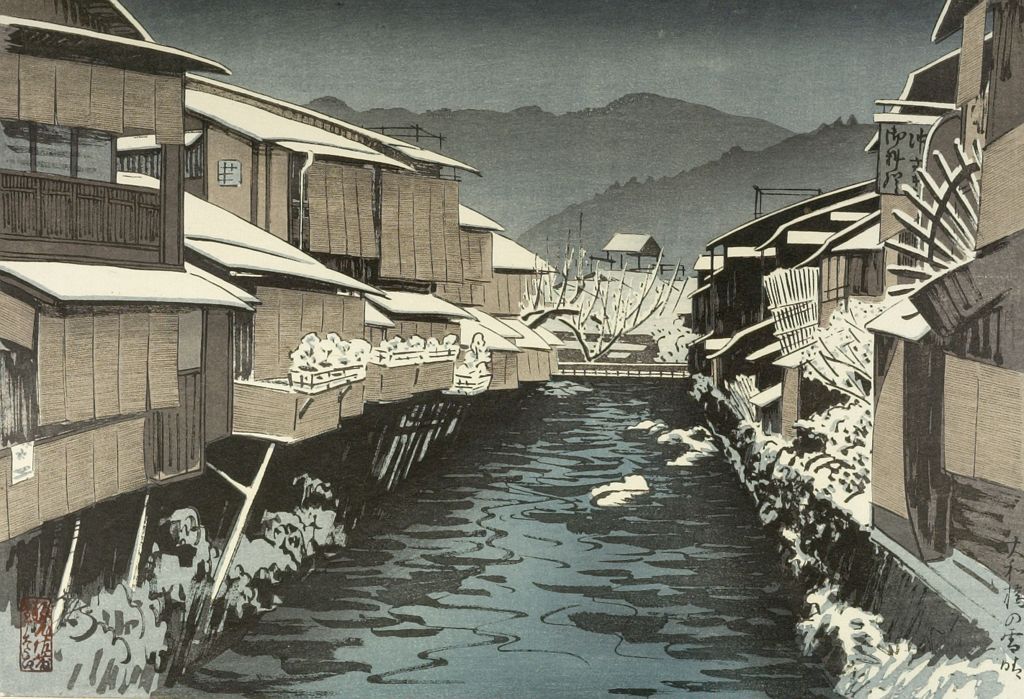
Fair Weather After Snow at Yamato Bridge, Kyoto (Yamato bashi no yukibare), Taishô period, dated 1924
Woodblock print

The Compound of the Tenman Shrine at Kameido in the Snow (Kameido Tenmangu keidai no yuki), from the series "Famous Places in the Eastern Capital (Toto meisho)"
c. 1832/38
Color woodblock print; oban

Miyajima in Snow (Yuki no Miyajima)
Yuki no Miyajima
1929
Color woodblock print; oban
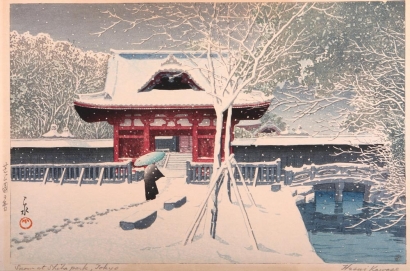
Evening Snow at Shiha Park, Tokyo
1932
Woodblock print
Frequently Asked Questions
Ginkakuji in Snow was created by Ray Morimura (森村玲).
Ginkakuji in Snow depicts snow scenes.