
Kaiji (Temple by the Sea)
by Ray Morimura
- Medium:
- Mokuhanga (Japanese woodblock)
- Image courtesy of
- Hanga Ten
Description
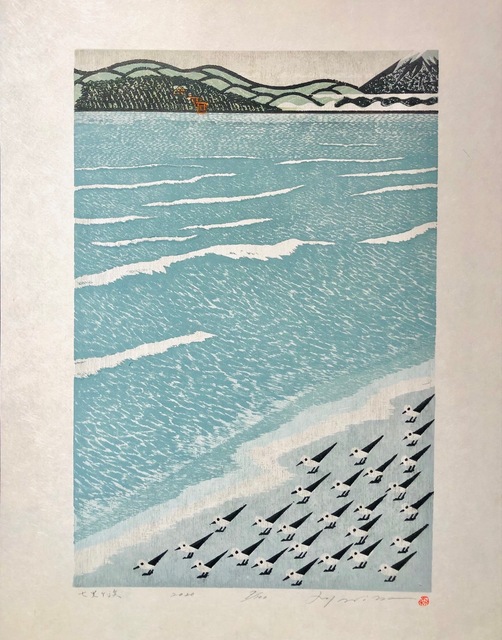
Kaiji, literally 'sea temple,' depicts a Buddhist temple complex set on or near the coast, joining the seascape and temple subjects that recur throughout Morimura's catalogue. The composition is likely organized around tiled roofs, a pagoda or main hall, and a torii or stone steps reading against an expanse of patterned water and sky, with each element pared down to the artist's signature interlocking geometric shapes. Mokuhanga technique allows him to print the sea as a deliberate woodgrain pattern or as flat banded blues — a contemporary equivalent to the wave conventions of Edo meisho-e — while temple architecture is articulated through carefully registered keyblock outlines and small accents of vermilion or gold. Coastal temples such as those of the Izu and Kii peninsulas have long figured in Japanese landscape printmaking, and Morimura's treatment continues that tradition while filtering it through his late-twentieth and early twenty-first-century idiom of stylized, almost diagrammatic clarity.
More Prints by Ray Morimura


More Temples & Shrines Prints

Fushimi Inari Temple
伏見稲荷
Woodblock print

The Compound of the Tenman Shrine at Kameido in the Snow (Kameido Tenmangu keidai no yuki), from the series "Famous Places in the Eastern Capital (Toto meisho)"
c. 1832/38
Color woodblock print; oban
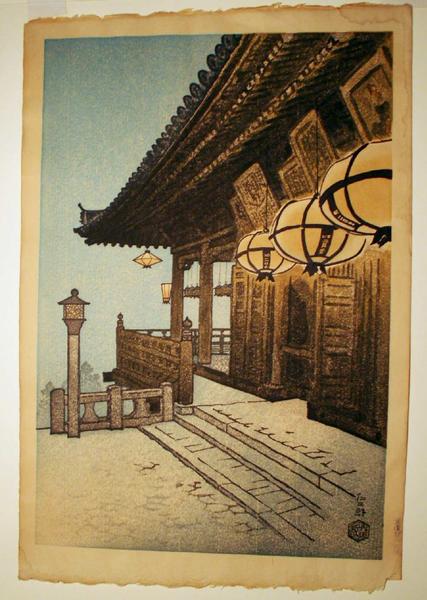
Temple with lanterns
Woodblock print

A Section of the Byodo Temple at Uji (Uji Byodoin no ichibu), from the series "Souvenirs of Travel, Second Series (Tabi miyage dai nishu)"
Uji Byodoin no ichibu
1921
Color woodblock print; oban
Featured in Collections
Curated cross-cuts that include this print.
Frequently Asked Questions
Kaiji (Temple by the Sea) was created by Ray Morimura (森村玲).
Kaiji (Temple by the Sea) depicts temples & shrines and seascapes.