
Kanjuji in Snow
by Ray Morimura
- Medium:
- Mokuhanga (Japanese woodblock)
- Image courtesy of
- Hanga Ten
Description
Kanjuji is a Shingon temple in the Yamashina district of Kyoto, founded in 900 and known for its lotus pond, dry garden, and unpainted timber halls. Morimura's snow scene likely silences the site under a heavy white blanket, with roof ridges and stone lanterns reduced to crisp dark silhouettes against the unprinted washi that does the work of snow. Snow in mokuhanga is conventionally rendered by leaving paper bare and shaping its edge through the surrounding blocks, a technique Morimura uses with characteristic precision; bokashi gradations along the eaves and at the horizon would soften the transition between snow-laden surface and overcast sky. The composition probably balances asymmetrical mass — a single weighted hall, a leaning pine — against expanses of quiet ground. Within his oeuvre, Kanjuji belongs to a substantial winter group that includes Ryoanji and Kinkakuji under snow, sharing with the shin-hanga winter prints of Hasui and Yoshida a fascination with how seasonal cover transforms familiar architecture into something hushed and elemental.
More Prints by Ray Morimura


More Snow Scenes Prints
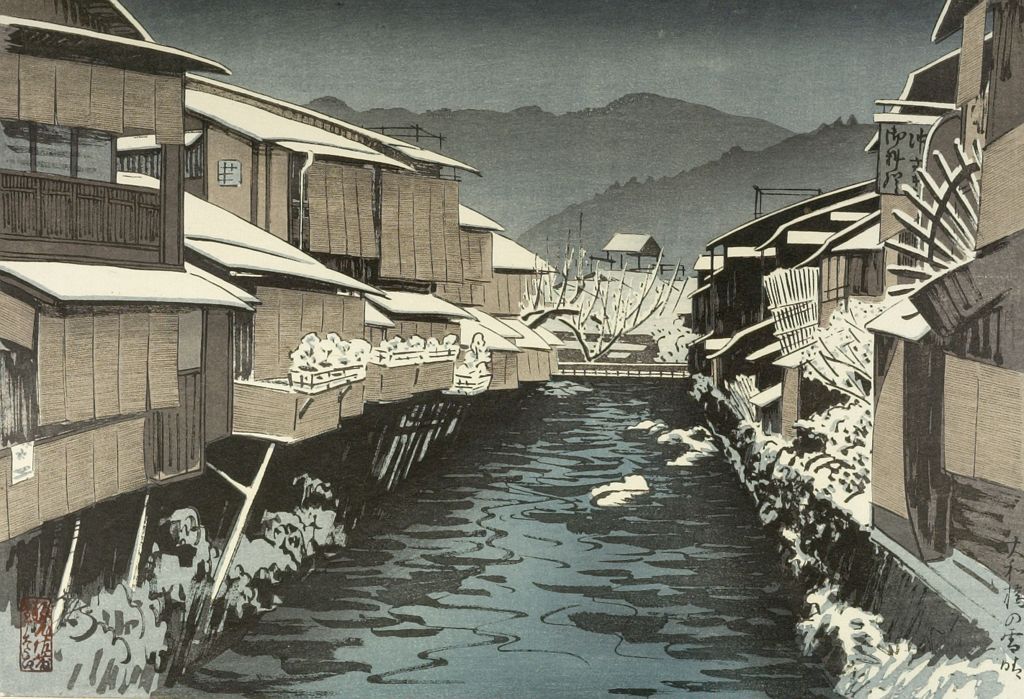
Fair Weather After Snow at Yamato Bridge, Kyoto (Yamato bashi no yukibare), Taishô period, dated 1924
Woodblock print

The Compound of the Tenman Shrine at Kameido in the Snow (Kameido Tenmangu keidai no yuki), from the series "Famous Places in the Eastern Capital (Toto meisho)"
c. 1832/38
Color woodblock print; oban

Miyajima in Snow (Yuki no Miyajima)
Yuki no Miyajima
1929
Color woodblock print; oban
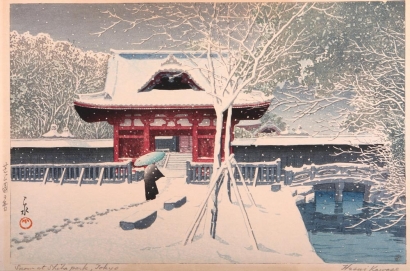
Evening Snow at Shiha Park, Tokyo
1932
Woodblock print
Frequently Asked Questions
Kanjuji in Snow was created by Ray Morimura (森村玲).
Kanjuji in Snow depicts snow scenes.