
Miyamairi (Visiting the Shrine)
by Ray Morimura
- Medium:
- Mokuhanga (Japanese woodblock)
- Image courtesy of
- Hanga Ten
Description
Miyamairi is the traditional first shrine visit of an infant, typically around the thirtieth day after birth, with the child carried in formal kimono by grandmother or mother through a torii gate. Morimura's print likely depicts the figures in ceremonial dress passing beneath the vermilion gate or along a gravel approach, the family rendered in flat planes of patterned cloth set against the larger architectural geometry of the shrine. Unlike most of his work, which is unpopulated or only sparsely figured, miyamairi requires human presence as the subject's reason for being. Figures in his work are characteristically reduced — a kimono pattern, the curve of an obi, the rounded back of a swaddled infant — without facial detail, retaining the diagrammatic clarity of his architectural pieces. Within his temples-and-shrines body of work, this print pairs ritual life with sacred space, joining other ceremonial subjects such as shichigosan and hatsumode in showing the shrine not as monument but as setting for the lived calendar of Japanese family observance.
More Prints by Ray Morimura


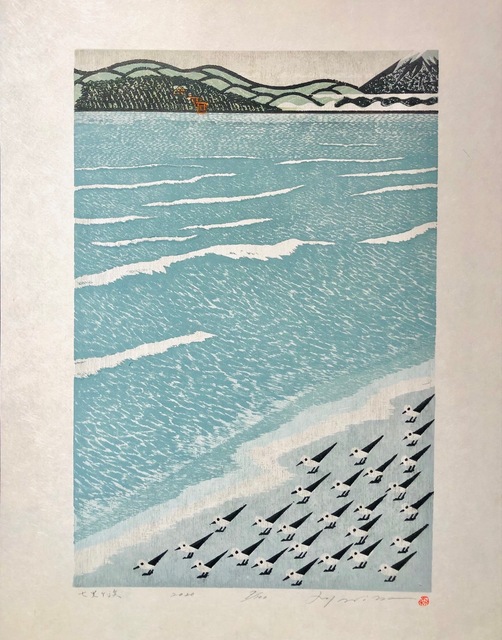
More Temples & Shrines Prints
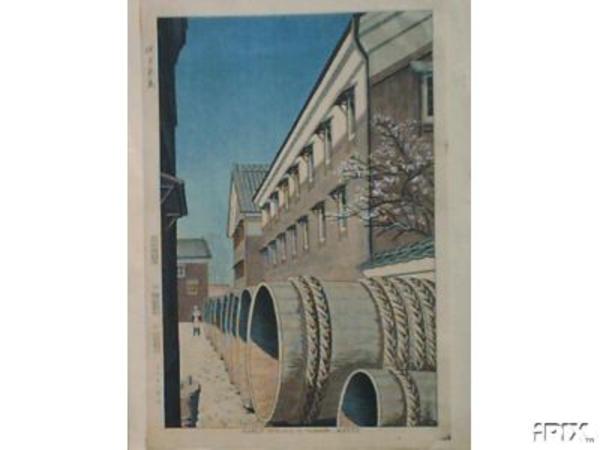
Fushimi Inari Temple
伏見稲荷
Woodblock print

The Compound of the Tenman Shrine at Kameido in the Snow (Kameido Tenmangu keidai no yuki), from the series "Famous Places in the Eastern Capital (Toto meisho)"
c. 1832/38
Color woodblock print; oban
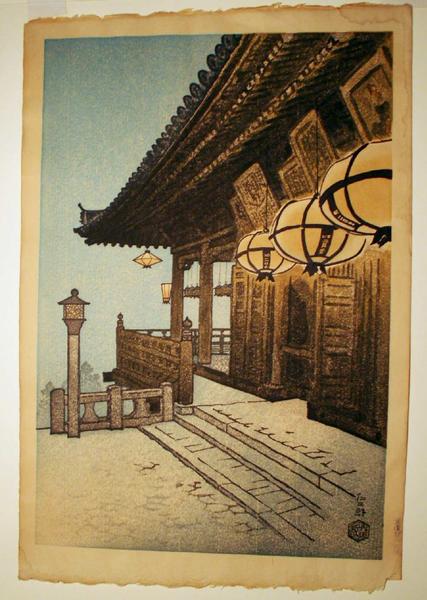
Temple with lanterns
Woodblock print

A Section of the Byodo Temple at Uji (Uji Byodoin no ichibu), from the series "Souvenirs of Travel, Second Series (Tabi miyage dai nishu)"
Uji Byodoin no ichibu
1921
Color woodblock print; oban
Featured in Collections
Curated cross-cuts that include this print.
Frequently Asked Questions
Miyamairi (Visiting the Shrine) was created by Ray Morimura (森村玲).
Miyamairi (Visiting the Shrine) depicts temples & shrines.