
Biblical print - Noah's Ark
- Source:
- ukiyo-e.org
Description
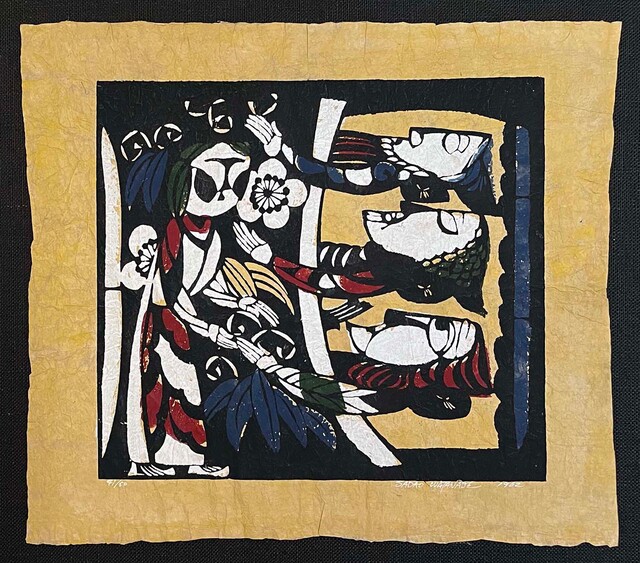
Noah's Ark provided Sadao Watanabe with one of his richest visual subjects, allowing him to populate a single composition with the entire animal kingdom rendered in his distinctive folk style. This biblical print, archived through ukiyo-e.org's documentation of Watanabe's biblical works, shows the great ark of Genesis transformed into a vessel that might have plied the rivers of pre-industrial Japan, carrying creatures stylized like figures from folk toys or Otsu-e paintings. Watanabe (1913-1996), Japan's foremost Christian Japanese woodblock and stencil-dyed printmaker, drew on his training under Living National Treasure Serizawa Keisuke to develop the katazome technique into a vehicle for biblical narrative. His approach was deeply mingei-influenced, rooted in Yanagi Soetsu's conviction that authentic beauty emerged from anonymous folk craftsmanship using indigenous materials. Watanabe printed Noah's Ark and his other scriptural scenes on momigami, the kneaded mulberry paper whose textured surface gives his works the appearance of weathered hide or ancient parchment. The animals in this composition would be rendered with the flat, frontal simplicity characteristic of Japanese folk art, paired off in the orderly procession described in Genesis 7 and arranged across the ark's hull in a decorative frieze that recalls both Buddhist paradise mandalas and the painted ema votive tablets of Shinto shrines. A convert to Christianity at seventeen, Watanabe believed each culture must retell biblical stories in its own visual idiom, and the Flood narrative gave him a uniquely Japanese opportunity, since rural Japan's relationship with rivers, floods, and the boats that survived them resonated deeply with the Old Testament account. His Noah prints have entered collections at the Museum of Modern Art, the Vatican Museum, and the British Museum.
More Prints by Sadao Watanabe


Featured in Collections
Curated cross-cuts that include this print.
Frequently Asked Questions
Biblical print - Noah's Ark was created by Sadao Watanabe (渡辺禎雄).