
The Deposition
- Source:
- ukiyo-e.org
Description
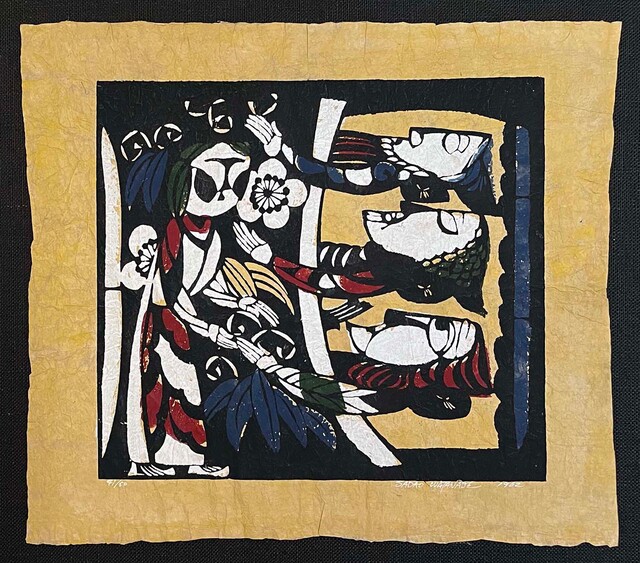
The Deposition presents Sadao Watanabe's interpretation of one of Christian art's most emotionally weighted subjects, the moment when Christ's body is taken down from the cross, rendered with the iconic restraint and folk simplicity that defined his lifelong devotional practice. This print, recorded in ukiyo-e.org's archive of Watanabe's biblical works, transforms a scene that European artists from Rogier van der Weyden to Caravaggio rendered with dramatic anguish into a composition of quiet, flat-planed solemnity. Watanabe (1913-1996), Japan's foremost creator of Christian Japanese woodblock and stencil-dyed prints, drew on his training under Living National Treasure Serizawa Keisuke to develop the katazome technique into a vehicle for biblical narrative that consciously rejected Western pictorial drama. His mingei-influenced approach prized the flatness, frontality, and ornamental power of Japanese folk art, treating Christ and the mourning figures around him with the iconic dignity traditionally given to Buddhist deities. The print's surface owes its distinctive weathered quality to momigami, the heavy mulberry paper Watanabe kneaded by hand until it took on the texture of ancient leather or parchment. Through hand-cut stencils, he applied natural dyes in successive layers, building compositions whose simplicity belies the sophistication of their craft. A Christian convert from age seventeen, Watanabe believed that scripture had to be retold in each culture's visual idiom, and the Deposition gave him an opportunity to express the universal human experience of grief through specifically Japanese forms. His Deposition and related Passion subjects have entered the collections of the Vatican Museum, the Museum of Modern Art, the Cleveland Museum of Art, and numerous parish churches around the world, where they continue to function as living devotional images rather than museum pieces.
More Prints by Sadao Watanabe


Featured in Collections
Curated cross-cuts that include this print.
Frequently Asked Questions
The Deposition was created by Sadao Watanabe (渡辺禎雄).