
Untitled work by Sadao Watanabe
- Source:
- ukiyo-e.org
Description
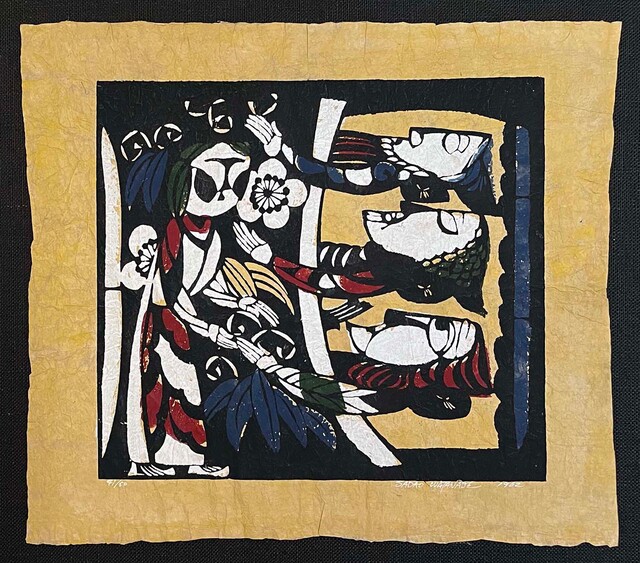
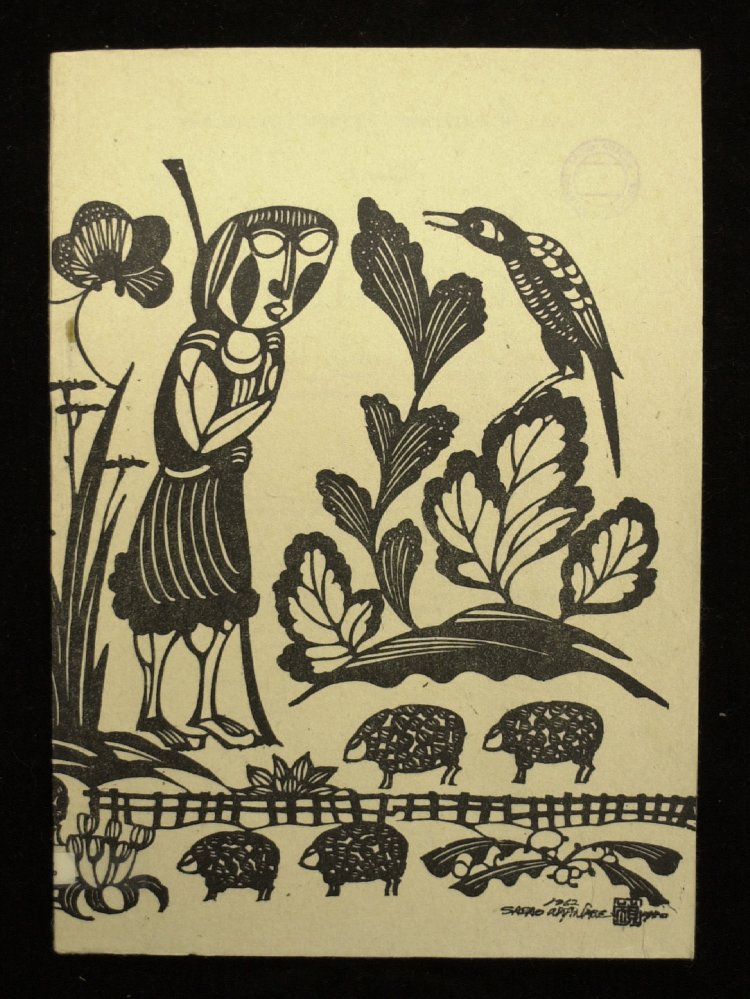
This untitled work by Sadao Watanabe, recorded in ukiyo-e.org's archive of his oeuvre, exemplifies the unique visual language he developed for translating Christian narrative into a distinctly Japanese pictorial idiom. As Japan's foremost creator of Christian Japanese woodblock and stencil-dyed prints, Watanabe (1913-1996) spent more than fifty years rendering biblical scenes through the katazome technique he learned from Living National Treasure Serizawa Keisuke. Watanabe's approach grew directly from the mingei-influenced folk craft movement, which held that the highest art arose from humble materials worked by trained hands for everyday use. He applied stencil patterns and natural dyes to momigami, a heavy mulberry paper kneaded by hand to create a wrinkled, parchment-like texture reminiscent of ancient manuscripts. The resulting prints possess a primitive monumentality that recalls both medieval Coptic icons and Japanese folk Buddhist paintings, even when no specific scriptural subject is identified. Watanabe converted to Christianity at age seventeen, and from that point forward devoted his artistic practice almost exclusively to scenes from the Bible. He believed deeply that biblical stories had to be retold in the visual vocabulary of each culture, just as the New Testament itself had been translated into Greek from the Aramaic of Jesus and his followers. This untitled print likely depicts one of his recurring subjects, drawn from a body of work that includes the Last Supper, the Nativity, the Annunciation, scenes from Genesis and Exodus, and parables of Christ. His figures wear flowing kimono-like robes, their faces stylized into mask-like simplicity, while symbolic plants, fish, and birds populate the surrounding fields, reflecting both Japanese folk imagery and early Christian iconography.
More Prints by Sadao Watanabe


Featured in Collections
Curated cross-cuts that include this print.
Frequently Asked Questions
(untitled) was created by Sadao Watanabe (渡辺禎雄).