
shin-arakawa-20269
- Medium:
- Mokuhanga (Japanese woodblock)
- Image courtesy of
- Saru Gallery
Description
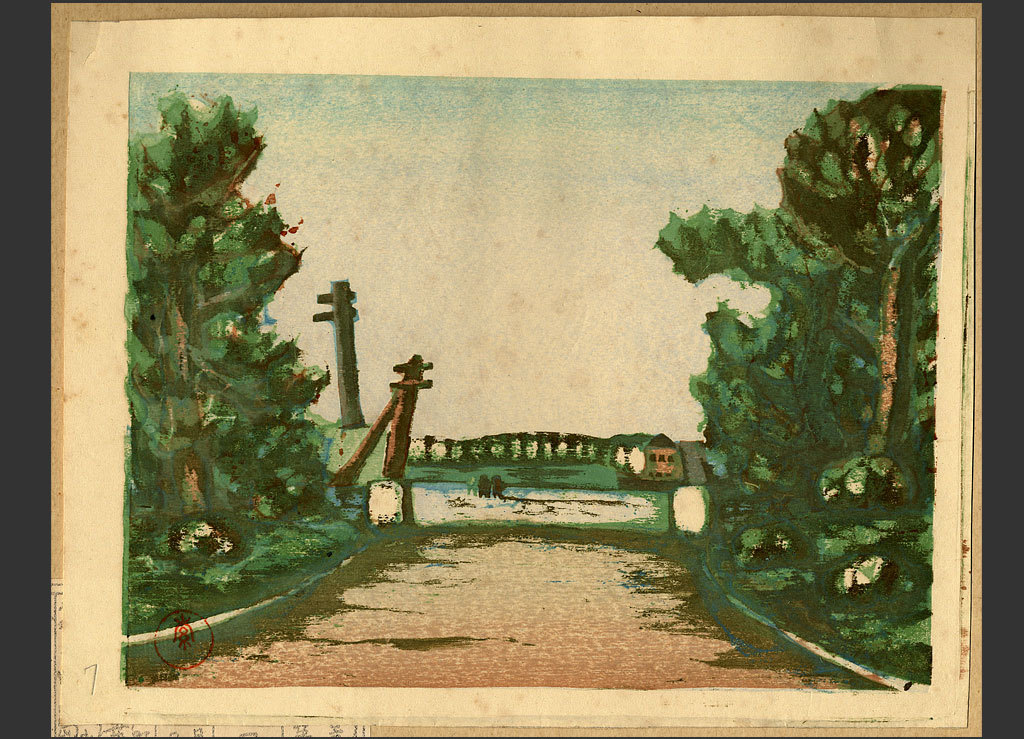
Shin-Arakawa, the 'new Arakawa' (新荒川), refers to the artificial flood-discharge channel cut through northeastern Tokyo between 1913 and 1930 to relieve the older river of seasonal flooding. The print likely shows the broad engineered watercourse with its embankments and sluice infrastructure — a subject that drew sosaku-hanga artists precisely because it sat outside the conventional repertoire of meisho-e. Fukazawa belonged to a generation of printmakers willing to record dredged channels, gasworks, and rail yards as legitimate landscape. The technical signature of such work is the unidealized treatment of industrial form: planar cuts, restrained palette, often with bokashi gradation reserved for sky or water rather than applied decoratively across the design. Through the 1930s, Fukazawa exhibited regularly with the Nihon Sosaku-Hanga Kyokai, where works in this vein were positioned as modern Japanese prints made by a single artist's hand from drawing to baren — an explicit rejection of the publisher-centered division of labor that still governed shin-hanga production.
More Prints by Sakuichi Fukazawa

Featured in Collections
Curated cross-cuts that include this print.
Frequently Asked Questions
shin-arakawa-20269 was created by Sakuichi Fukazawa (深沢索一).