
tsukiji-20268
- Medium:
- Mokuhanga (Japanese woodblock)
- Image courtesy of
- Saru Gallery
Description
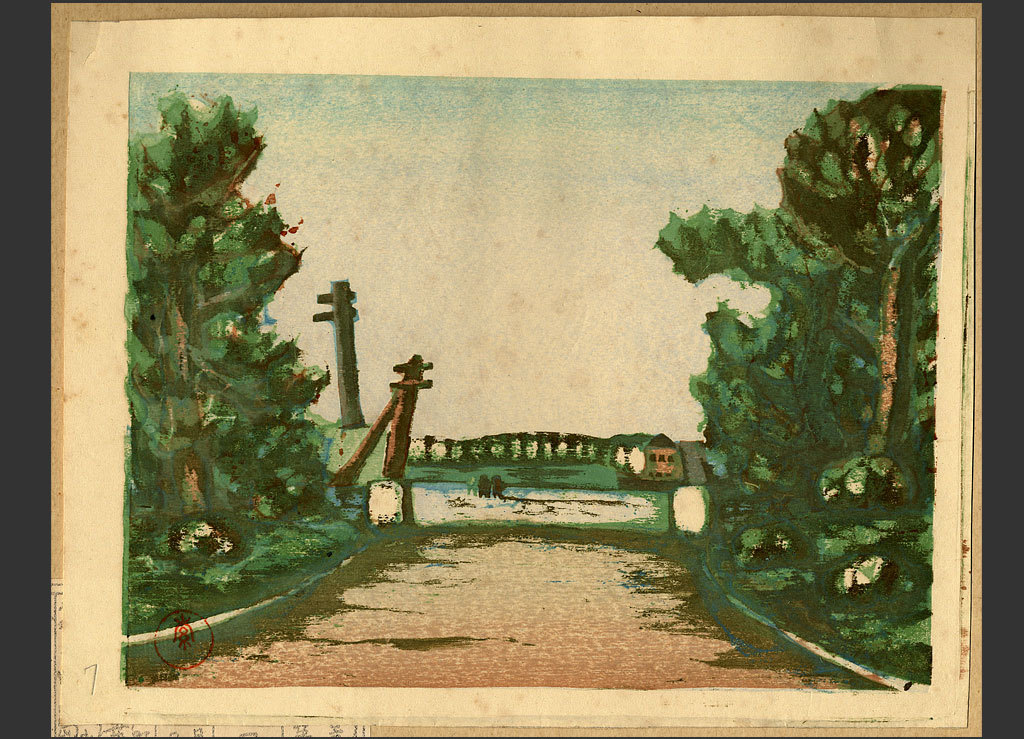
Tsukiji (築地), literally 'reclaimed land,' is the district on Tokyo Bay built atop landfill in the seventeenth century and best known in Fukazawa's lifetime as the site of the central wholesale fish market relocated there in 1935. The print likely depicts the area's wharves, warehouses, or canal frontages — vernacular waterfront subjects that sosaku-hanga artists favored over the ceremonial precincts of older Edo. Compositionally, prints of this type typically rely on flat color planes registered without elaborate gradient bokashi, and on the visible texture of self-carved blocks. Fukazawa's Tokyo views form a sustained record of the city's working districts during the interwar years, distinct in tone from the lyrical evening scenes Hasui produced for shin-hanga publishers. As a member of the Nihon Sosaku-Hanga Kyokai, Fukazawa pursued the principle of jiga jikoku jizuri — the artist drawing, carving, and printing the work alone — and the resulting prints carry the unmediated mark of the gouge in a way that was central to the movement's identity.
More Prints by Sakuichi Fukazawa

Featured in Collections
Curated cross-cuts that include this print.
Frequently Asked Questions
tsukiji-20268 was created by Sakuichi Fukazawa (深沢索一).