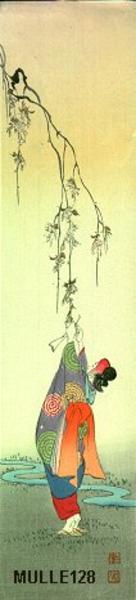
Beauty
by Shōda Kōhō
- Date:
- early 20th century
- Medium:
- Color woodblock print; tanzaku (pillar print)
- Source:
- Japanese Art Open Database
Description
This narrow vertical [tanzaku](/glossary/tanzaku) print, measuring approximately 7.6 by 33 cm, is among Shōda Kōhō's tanzaku-format designs produced for Hasegawa-Nishinomiya, likely as part of his collaborative series with Yoshimoto Gessō. The composition depicts a single female figure — a bijin — standing against a cherry branch that descends through the upper part of the image. The format is the traditional [hashira-e](/glossary/hashira-e) (pillar print) dimension, designed to be hung on a wooden post inside a Japanese house, and the narrow vertical field forces the composition into a strict top-to-bottom organisation. Shōda's solution here is characteristic: the figure is held at the lower third of the picture, the cherry branch occupies the upper two-thirds, and the broad expanse of unprinted [washi](/glossary/washi) between them creates an aerated sense of open interior space. The bijin is rendered in a restrained palette of pale rose for the kimono, deeper indigo for the obi, and warm cream for the exposed skin, with the cherry blossoms picked out in pale pink against the warmer ground. The print is documented in the Robert O. Muller research files now catalogued at the Japanese Art Open Database. [Bijin-ga](/glossary/bijin-ga) is an unusual subject in Shōda's broadly landscape- and bird-focused oeuvre, suggesting that he was extending his range during the period of the Hasegawa-Nishinomiya tanzaku project, which encompassed roughly ninety-six different images across multiple subject categories and gave each contributing artist the opportunity to work outside his customary specialism. The print bears Shōda's red Kō and Hō seals at the lower right.