
Snow village
- Medium:
- Mokuhanga (Japanese woodblock)
- Image courtesy of
- Saru Gallery
Description
Snow village (yuki no mura) is a recurring subject in twentieth-century mokuhanga, taken up extensively by Kawase Hasui and others working in the shin-hanga and sōsaku-hanga traditions. The print likely depicts clustered rooftops under accumulated snow, with the white of the unprinted washi paper carrying the snow itself — a technical convention that exploits the paper's tone rather than printing white pigment. Roof lines, tree branches, and distant hills are typically rendered in dark sumi-toned blocks that register against this reserved white, with bokashi used in the sky to suggest overcast or twilight conditions. Architectural details — eaves, fences, smoke from a chimney — give scale and human presence to the scene without populating it with figures. The print belongs to the winter end of Miyamoto Shufu's seasonal landscape work, and aligns with the broader twentieth-century mokuhanga interest in rural Japan as a subject of quiet documentary attention rather than narrative incident.
More Prints by Miyamoto Shufu

More Snow Scenes Prints
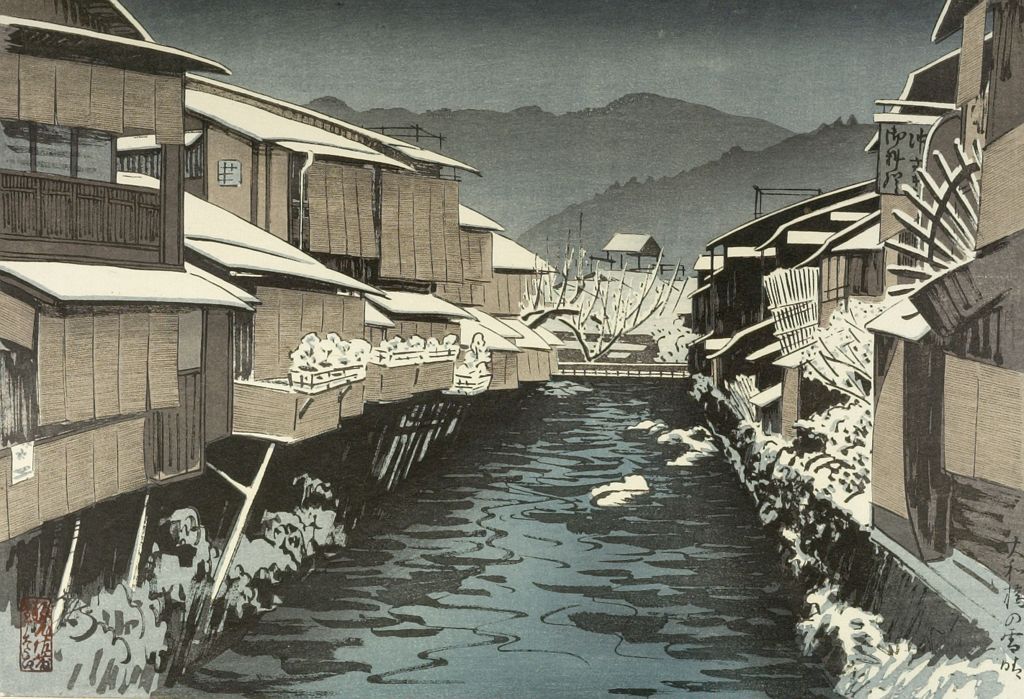
Fair Weather After Snow at Yamato Bridge, Kyoto (Yamato bashi no yukibare), Taishô period, dated 1924
Woodblock print

The Compound of the Tenman Shrine at Kameido in the Snow (Kameido Tenmangu keidai no yuki), from the series "Famous Places in the Eastern Capital (Toto meisho)"
c. 1832/38
Color woodblock print; oban

Miyajima in Snow (Yuki no Miyajima)
Yuki no Miyajima
1929
Color woodblock print; oban
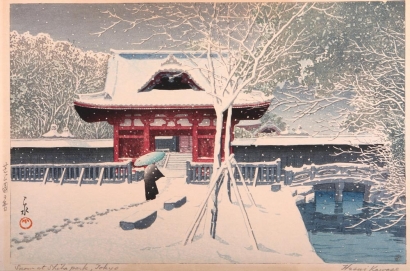
Evening Snow at Shiha Park, Tokyo
1932
Woodblock print
Frequently Asked Questions
Snow village was created by Miyamoto Shufu (宮本秋風).
Snow village depicts snow scenes and village scenes.