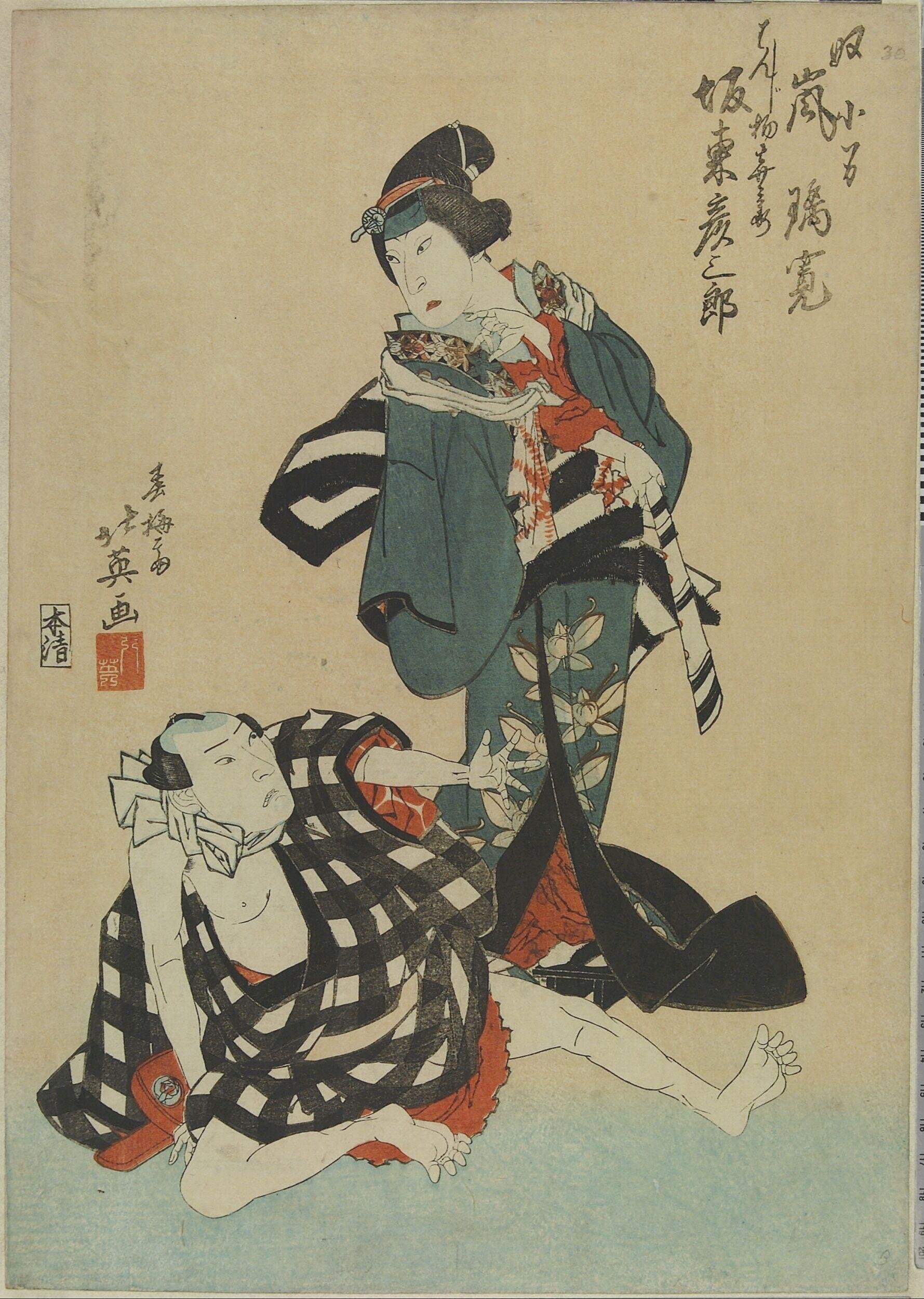
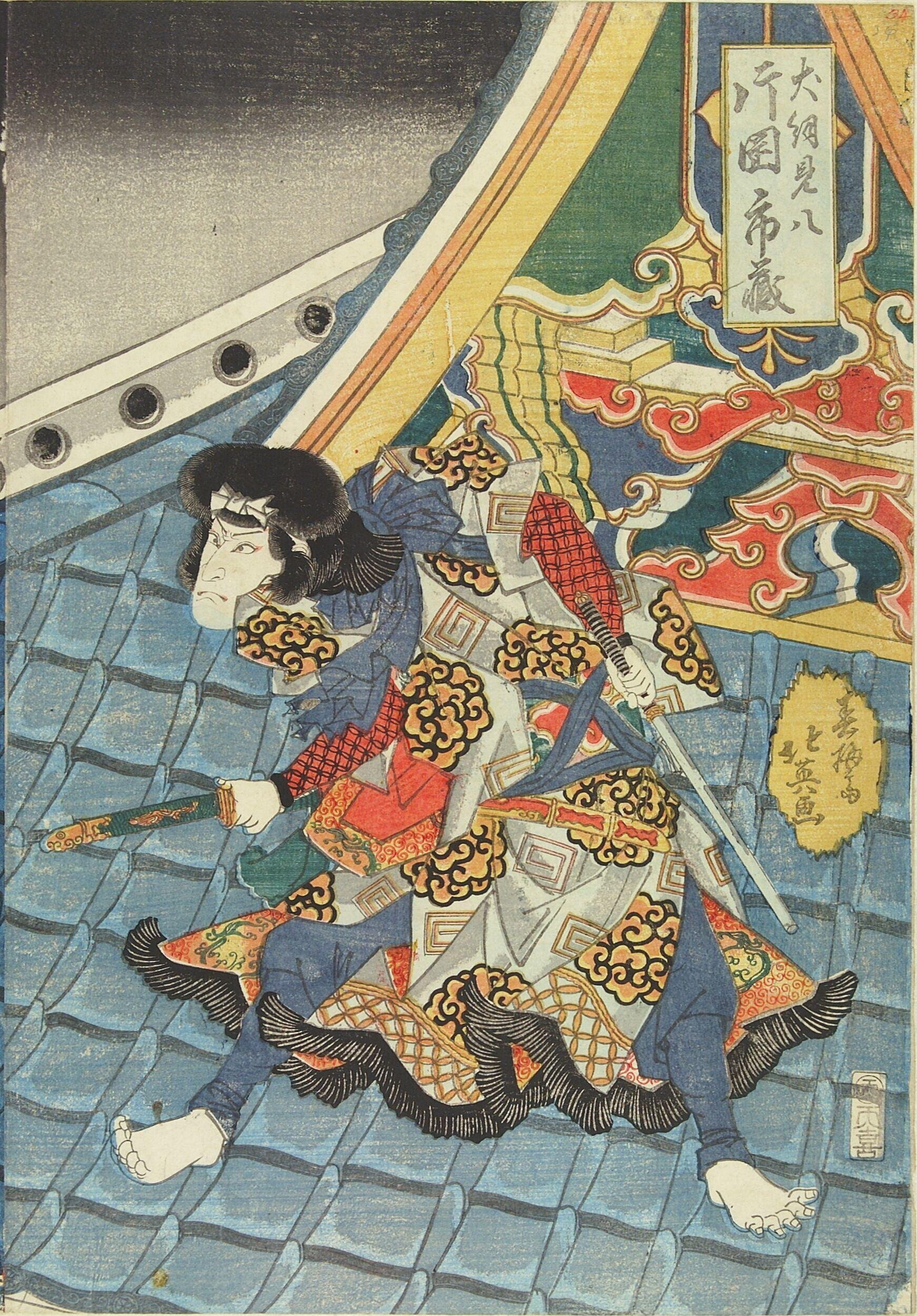
Actors Arashi Rikan as Yakko no Koman and Bandō Hikosaburō as Hanjimono Kihei
- Date:
- 1834
- Medium:
- Source:
- Victoria and Albert Museum
Description
This 1834 yakusha-e by Shunbaisai Hokuei, in the Victoria and Albert Museum (https://collections.vam.ac.uk/item/O419907), pairs Arashi Rikan II as Yakko no Koman with Bando Hikosaburo as Hanjimono Kihei, a double portrait drawn from one of the 1834 Osaka kabuki productions. Yakko no Koman ("Koman the servant") was one of the celebrated otokodate-style female roles of the period, a vigorous and chivalrous townswoman type that gave male actors playing female roles an opportunity to combine onnagata costume conventions with a more assertive performance register than the standard noble or courtesan parts demanded. The pairing with Hanjimono Kihei (the surname suggesting a riddler or puzzle-master, hanjimono meaning rebus or wordplay) suggests a sewamono (domestic drama) context in which the two contrasting figures interact in a scene of urban townsman life. Both actors brought distinctive Kamigata acting lineage to the production: Rikan II as the leading male-role star of the Osaka stage performing here in an unusual cross-gender role, and Bando Hikosaburo providing the male character against whom Rikan II's onnagata-but-vigorous Koman is set. Hokuei orchestrates the two figures with attention to their distinct costume and bearing while preserving the personal-likeness of each actor. The double-figure composition demonstrates the Kamigata-e school's interest in capturing the relational drama of kabuki staging in ways that single-figure portraits could not, with the spatial and gestural orientation of the two actors conveying the dramatic moment of their stage interaction. The Victoria and Albert impression preserves the careful color registration of Hokuei's premium-grade workshop output and allows the precise gestural choreography of the double composition to register today essentially as the artist intended.
More Prints by Shunbaisai Hokuei
Frequently Asked Questions
Actors Arashi Rikan as Yakko no Koman and Bandō Hikosaburō as Hanjimono Kihei was created by Shunbaisai Hokuei (春梅斎北英) in 1834.