
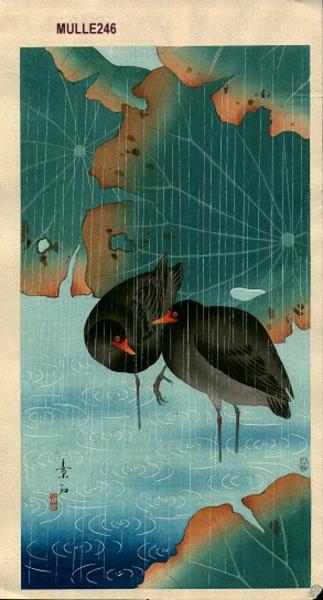
Moorehens in the Rain
- Source:
- ukiyo-e.org
Description
Moorehens in the Rain is a kacho-e Japanese woodblock print attributed in ukiyo-e.org's catalogue to Soseki Komori, with a record that also references Ohara Koson, reflecting the close stylistic and subject-matter overlap between the two shin-hanga bird-and-flower specialists. The composition depicts moorhens, a small dark waterbird associated with reedy ponds and marshland, set against a slanting rainfall that defines the entire mood of the sheet. Rain in shin-hanga prints is a technical signature: the carver cuts very fine, evenly spaced parallel lines into a separate block, which the printer then runs across a darker tonal field to produce the impression of continuous downpour. Komori, like Koson, used this device to give kacho-e a dramatic, weather-bound register that elevated the everyday subject of waterfowl into something contemplative. The moorhens themselves are placed low in the composition, their dark bodies and characteristic red-fronted bills picked out against the muted greens, browns, and grays of a wet pondside. The shin-hanga movement, in which Soseki Komori worked, sought to renew the Edo-period collaborative printmaking tradition by pairing carefully trained carvers and printers with contemporary designers committed to naturalistic observation. Moorehens in the Rain shows that program clearly: the birds are anatomically credible and behaviorally specific (waterbirds hunkered down in a storm), while the production exploits bokashi gradation and the long parallel lines of rain to produce a unified atmospheric envelope. As a Japanese woodblock print, the work belongs to the kacho-e subgenre that shin-hanga publishers, especially Watanabe Shozaburo, made internationally popular among early-twentieth-century collectors. The impression is documented through ukiyo-e.org's union catalogue of Japanese print dealers and museum holdings.
More Prints by Komori Soseki
More Rain Prints

Rain Shower at Shо̄no, from the series Fifty-three Stations of the Tо̄kaidо̄ (Tо̄kaidо̄ gojusan tsugi)
1962
Woodblock print, ink and color on paper

Shōno: Driving Rain (Shōno hakuu), from the series Fifty-three Stations of the Tōkaidō (Tōkaidō gojūsan tsugi no uchi), also known as the First Tōkaidō or Great Tōkaidō
c. 1833-36
Woodblock print (nishiki-e); ink and color on paper

Omiya in Rain (Ame no Omiya)
Ame no Omiya
1930
Color woodblock print; oban

Evening Shower at Teradomari (Teradomari no yau), from the series "Souvenirs of Travel, Second Series (Tabi miyage dai nishu)"
Teradomari no yau
1921
Color woodblock print; oban
Featured in Collections
Curated cross-cuts that include this print.
Frequently Asked Questions
Moorehens in the Rain was created by Komori Soseki (小森漱石).
Moorehens in the Rain depicts rain.