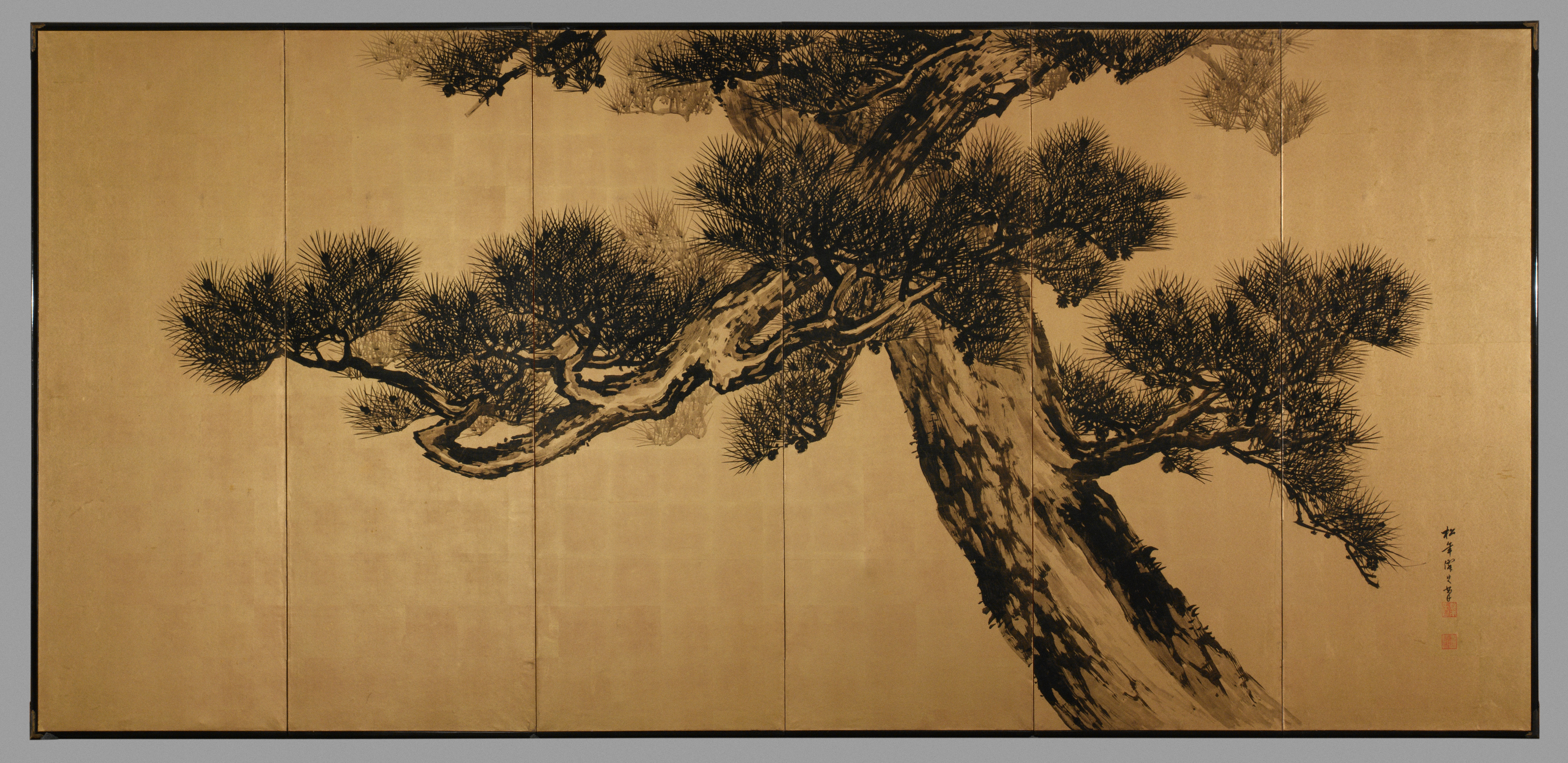
Aged Pines
- Date:
- Late 19th century
- Medium:
- Pair of six-panel folding screens; ink on gold-leaf
- Source:
- Metropolitan Museum of Art
Description
Held by the Metropolitan Museum of Art and dated to the late nineteenth century, this pair of six-panel folding screens is among the most ambitious of Shōnen's many pine-tree compositions. The screens depict ancient pines, their trunks twisted and gnarled by centuries of weather, rising across a field of brilliant gold leaf. The combination of monochrome ink trees against gold ground belongs to a tradition that stretches back to Tōhaku and the Kanō pine-screen masters of the Momoyama period, but Shōnen's treatment is distinctly his own: the trunks are worked in thick, wet, kinetic brush — almost calligraphic in feeling — and the needles are massed in clusters that catch the light against the metallic ground. The composition reads in a single sweep across all six panels, with the pines arched and individuated almost like portraits. The screens stand as one of his most direct statements of the Sinophile pine iconography that he had absorbed from his father, Suzuki Hyakunen, and that he reworked into a heroic late-Meiji idiom.
More Prints by Suzuki Shōnen


Frequently Asked Questions
Aged Pines was created by Suzuki Shōnen (鈴木松年) in Late 19th century.