
Biography
Suzuki Shōnen (鈴木松年, 1849–1918; many sources give his birth year as 1848) was a Kyoto-based painter of the late Edo and Meiji–Taishō periods whose career traced, in miniature, the trajectory of Japanese painting between the fall of the shogunate and the First World War. He was born in Kyoto as the eldest son of Suzuki Hyakunen (鈴木百年, 1825–1891), a largely independent Kyoto master whose vigorous atelier worked outside the inherited orthodoxies of the Kanō and Tosa houses while drawing pragmatically on the Shijō school, the literati nanga tradition, Maruyama-style sketching from life, and a strong personal appetite for older Chinese painting. From childhood Shōnen trained in his father's studio, copying Hyakunen's compositions, mastering the loose Shijō brush, and absorbing the broad Sinophile culture that distinguished his father from many of his contemporaries.
The historical setting that shaped his adult career is essential to understanding his work. In 1869 the imperial court relocated from Kyoto to Tokyo, taking with it much of the patronage that had sustained the old capital's painters for centuries, and Kyoto entered a period of economic decline that its leadership consciously sought to reverse through industrial exhibitions, design schools, and a new attention to the export market. Painting was enlisted directly in this project. In 1880 the Kyoto Prefectural School of Painting (京都府画学校, Kyōto-fu Gagakkō) — among the first public painting schools in Japan — opened, and the young Shōnen, then in his early thirties, entered its service that year. The following year he was appointed a teacher in the school's Northern-school (Hokushū) section, and he remained on its faculty until 1888, becoming a mainstay of the Kyoto painting world.
From these years Shōnen acquired a body of pupils that would prove disproportionately influential; among them were Tsuchida Bakusen, Niwayama Kōen, Yukawa Shōdō, Suzuki Shōsen, and — most famously — a young girl born into a Kyoto tea-merchant family, Uemura Tsune, who entered the school in 1887 at the age of twelve and studied under him. She took the art-name Shōen (松園), which shares the 松 ('pine') character of her teacher's own name, and went on to become the most decorated woman painter of modern Japan — a recipient of the Order of Culture and a designated Imperial Household Artist — whose classical bijinga carry, faintly but unmistakably, the sketch-trained linework and pale atmospheric washes of the Shijō manner she first absorbed in Shōnen's orbit. Uemura Shōen later studied under Kōno Bairei and then Takeuchi Seihō, but she is consistently remembered as Shōnen's pupil, and he is widely known today as her first master.
Shōnen's mature painting centered on a small group of subjects he returned to repeatedly: pine trees of great age, tigers and dragons, demons and folk-Buddhist iconography, landscapes, birds and flowers, and figural subjects drawn from Chinese poetry and Zen anecdote. His brushwork was bold and physical: where many Edo painters treated the pine as a flat decorative emblem in the Kanō manner or a delicate Shijō sketch, Shōnen worked his trunks in thick, wet ink with a force absorbed from his father's Sinophile practice and sharpened through the study of Chinese painting. That combative, unrestrained manner — paired with a famously intractable personality — led contemporaries to liken him to the eccentric Edo master Soga Shōhaku and to nickname him "Ima Shōhaku" (今蕭白), "the present-day Shōhaku." He worked rapidly, with calligraphic confidence, and among his temple commissions was a dragon painted for Tenryū-ji in Kyoto.
Shōnen worked across a range of formats — hanging scrolls, folding screens, sliding doors for temple commissions, hand-painted fans, and sumi studies on plain paper — but his relationship to woodblock printing is more oblique than that of the Edo ukiyo-e masters, which is part of what makes him interesting for a history of Japanese prints. He was not primarily a print designer; his income came from painting commissions, exhibition prizes, and teaching. But like most successful Kyoto painters of the Meiji period he also supplied designs that were carried into the woodblock medium — for illustrated books, for privately commissioned surimono, and for the luxurious color-printed picture albums (gafu and ehon) through which Kyoto-school painting reached a national audience of collectors in the 1890s and 1900s. Such albums helped establish the visual language of mature Meiji "Kyoto painting" as something distinct from the Tokyo Nihonga then emerging around the Tokyo School of Fine Arts.
He exhibited actively through the Meiji period, winning prizes at the first and second Naikoku Kaiga Kyōshinkai (Domestic Painting Competition) exhibitions in 1882 and 1884 and at the third and fourth Naikoku Kangyō Hakurankai (National Industrial Exposition) in 1890 and 1895, and receiving a bronze medal at the 1900 Exposition Universelle in Paris. He continued to teach a small group of pupils from his Kyoto atelier through his last years, and died in Kyoto on 29 January 1918.
In the longer arc of Japanese art history Shōnen occupies a transitional position. He was formed in the world of independent Kyoto Sinophile painting that flourished in the last years of the Edo period; he taught and worked through the institutional reforms of the early Meiji as one of the early faculty of the Kyoto painting school; and his pupils carried his example into the twentieth century. He remains best known to non-specialists as the first master of Uemura Shōen, but his own body of pine paintings, dragons, and bold ink landscapes stands as one of the more distinctive achievements of late-nineteenth-century Kyoto painting. His works are held in public collections in Japan and abroad — including the Indianapolis Museum of Art at Newfields — and in Kyoto temples such as Tenryū-ji.
Key Facts
- Active Period
- 1849–1918
- Nationality
- 🇯🇵Japan
- Movement
- Meiji/Taishō Prints
- Works Indexed
- 15
Frequently Asked Questions
Suzuki Shōnen (鈴木松年, 1849–1918; many sources give his birth year as 1848) was a Kyoto-based painter of the late Edo and Meiji–Taishō periods whose career traced, in miniature, the trajectory of Japanese painting between the fall of the shogunate and the First World War. He was born in Kyoto as the eldest son of Suzuki Hyakunen (鈴木百年, 1825–1891), a largely independent Kyoto master whose vigorous atelier worked outside the inherited orthodoxies of the Kanō and Tosa houses while drawing pragmatically on the Shijō school, the literati nanga tradition, Maruyama-style sketching from life, and a strong personal appetite for older Chinese painting. From childhood Shōnen trained in his father's studio, copying Hyakunen's compositions, mastering the loose Shijō brush, and absorbing the broad Sinophile culture that distinguished his father from many of his contemporaries.
Suzuki Shōnen was active from 1849 to 1918. They were associated with the Meiji/Taishō Prints movement.
Suzuki Shōnen's work was shaped by the Meiji/Taishō Prints tradition in Japanese woodblock printmaking. Meiji/Taishō Prints: Meiji and Taishō era prints (1868–1926) bridge the transition from traditional ukiyo-e to the modern shin-hanga and sosaku-hanga movements.
Suzuki Shōnen's prints frequently feature fish, moonlight.
Original prints by Suzuki Shōnen can be found in collections including Honolulu Museum of Art, Wikimedia Commons, Minneapolis Institute of Art, Metropolitan Museum of Art.
Woodblock Prints by Suzuki Shōnen (15)
Silhouette of a Fisherman and a Child
ca. 1881
Color woodblock print

Silhouette of a Man Seated on a Platform Enjoying the Scenery
ca. 1881
Color woodblock print

Silhouette of a Priest
ca. 1881
Color woodblock print
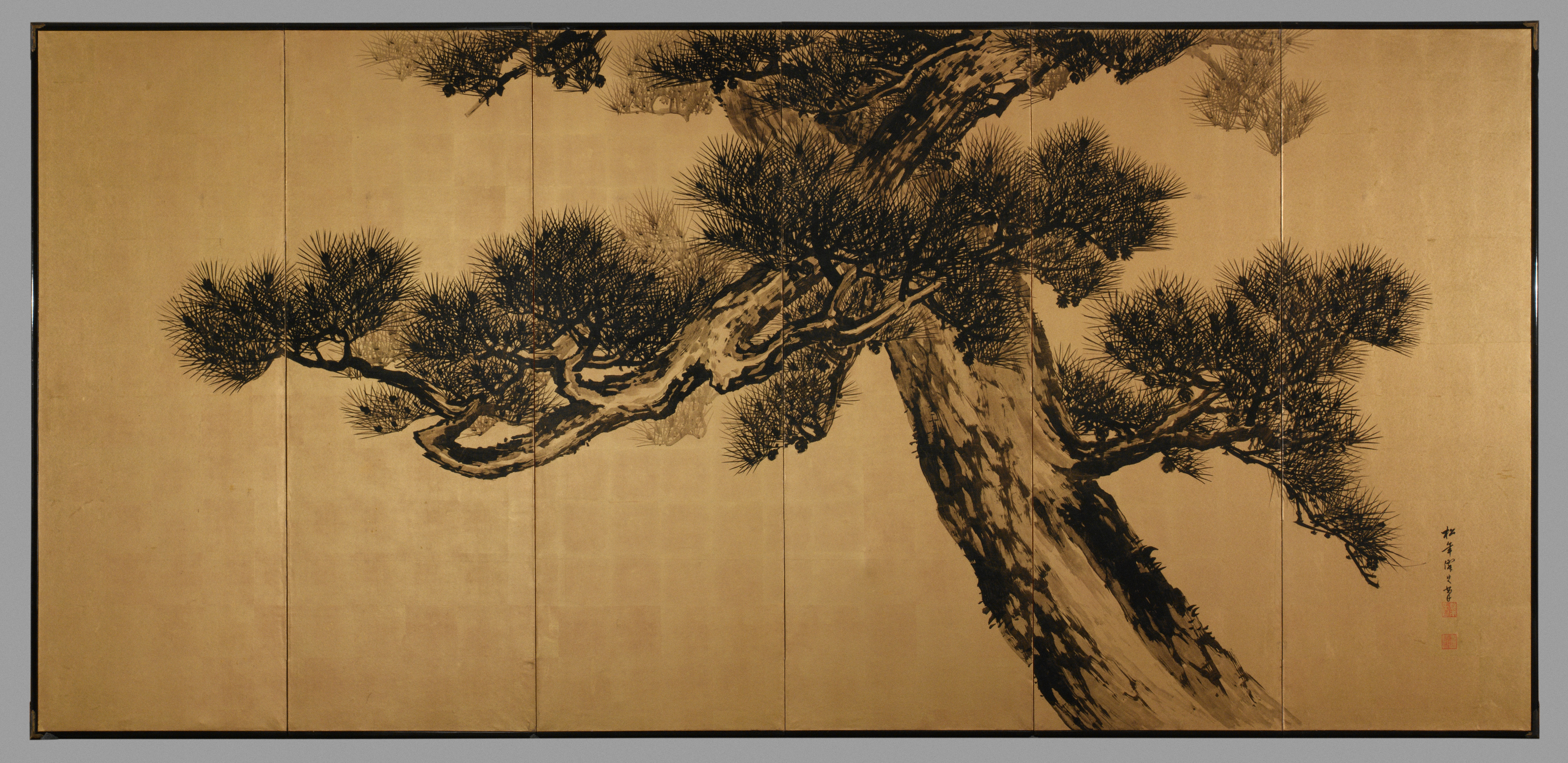
Aged Pines
Late 19th century
Pair of six-panel folding screens; ink on gold-leaf

Su Dongpo Laughing
1892
Hanging scrolls; ink and color on silk

Fireflies at Uji River
Late Meiji period
Hanging scroll; ink, color, and gold on silk

Old Pine
1900
Pair of six-panel folding screens; ink, color and gold on paper
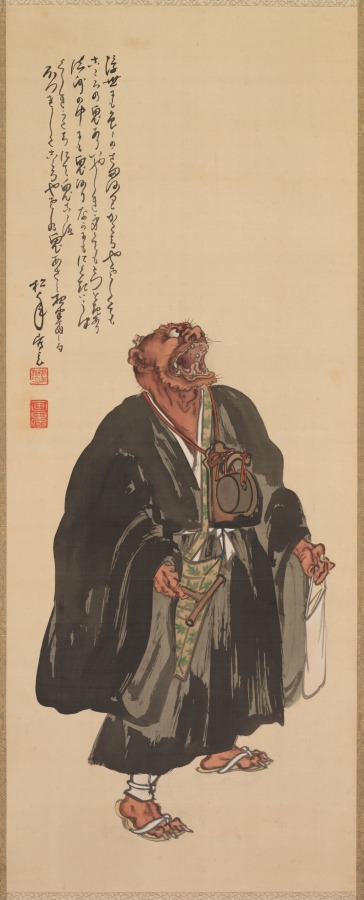
Demon Intoning the Name of the Buddha
鬼の念仏図
Late 1800s–early 1900s
Hanging scroll; ink and color on silk
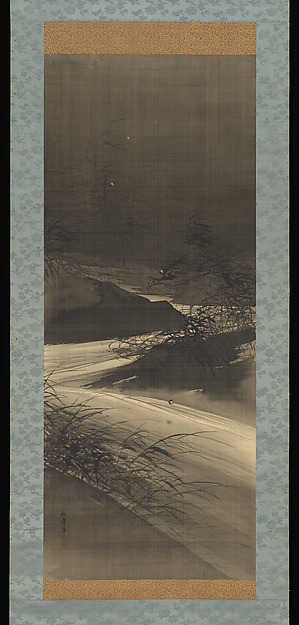
Fireflies Over the Uji River by Moonlight
Meiji period (1868–1912)
Hanging scroll; ink, color, and gold on silk

Celebrating Victory
1904
Hanging scroll; ink and color on paper

Looking Outside
ca. 1900–1910
Color woodblock print

December (surimono)
ca. 1900–1910
Woodblock print (surimono); ink and color on paper

Landscape with Boat in Rocky Stream
ca. 1900–1910
Color woodblock print

Pine
1916
Sumi ink on paper

Insect on a Chestnut Branch
1917
Hanging scroll; ink and color on silk