
Autumn sea
- Medium:
- Mokuhanga (Japanese woodblock)
- Image courtesy of
- Saru Gallery
Description
Autumn sea presents a coastal scene in which Yumeji's lyrical sensibility extends from his characteristic figure work into landscape. The composition likely employs the flat color planes and clean contour drawing that defined his synthesis of Art Nouveau decorative principles with mokuhanga tradition, with bokashi gradations used to render the transition between sea and sky and the shifting tones of autumn foliage along the shoreline. Yumeji approached landscape less as topographic record than as emotional setting, treating the seasonal subject as a vehicle for the wistful, introspective mood that pervaded Taisho-era visual culture. While he is principally remembered for bijin-ga of melancholy young women, his nature studies share the same poetic temperament — evoking solitude and the passage of time rather than identifying a specific named locale in the meisho-e tradition. The pairing of autumn foliage and sea draws on the classical Japanese association of autumn with impermanence, mono no aware, filtered through the Western-inflected modern idiom that made Yumeji the defining illustrator of his generation.
More Prints by Takehisa Yumeji

More Seascapes Prints
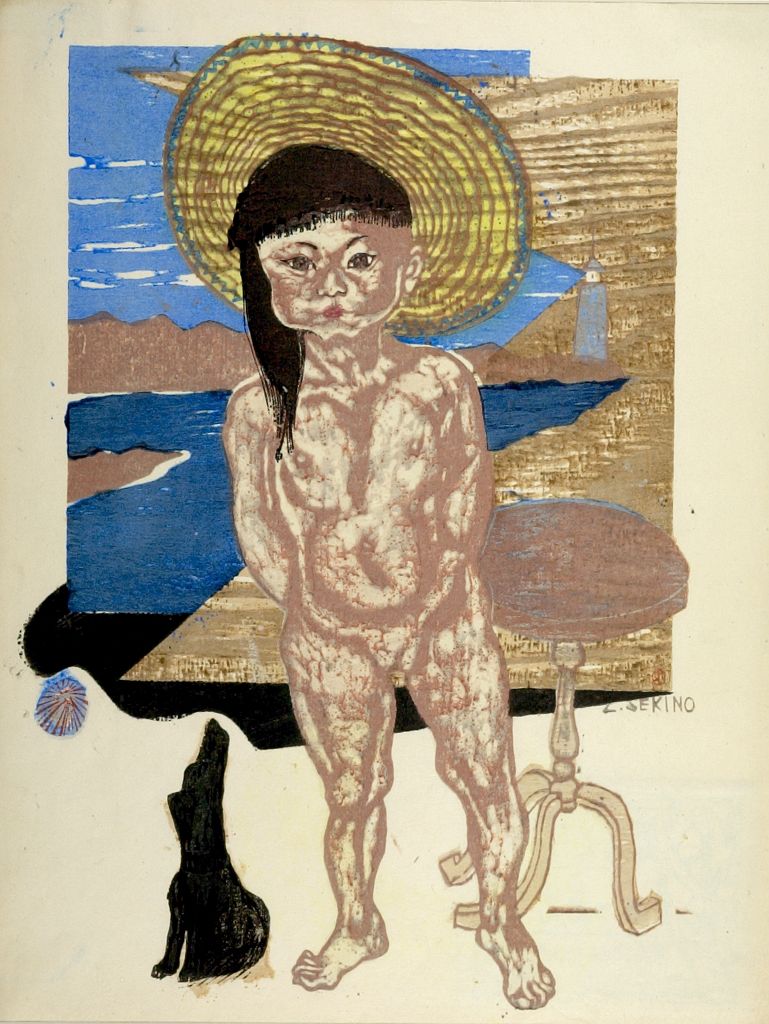
Child of the Sea
1940
Woodblock print

The Beach at Kaiganji in Sanuki Province (Sanuki Kaiganji no hama), from the series "Collection of Views of Japan II, Kansai Edition (Nihon fukei shu II Kansai hen)"
1934
Color woodblock print; oban

Pacific Ocean, Awa Province (Boshu Taikai), from the series "Souvenirs of Travel, Third Series (Tabi miyage dai sanshu)"
Boshu Taikai
1925
Color woodblock print; oban

Pine Beach at Miho (Miho no Matsubara), from the series "Selection of Views of the Tokaido (Tokaido fukei senshu)"
September 1931
Color woodblock print; oban
Frequently Asked Questions
Autumn sea was created by Takehisa Yumeji (竹久夢二).
Autumn sea depicts seascapes and autumn foliage.