
Spring evening
- Medium:
- Mokuhanga (Japanese woodblock)
- Image courtesy of
- Saru Gallery
Description
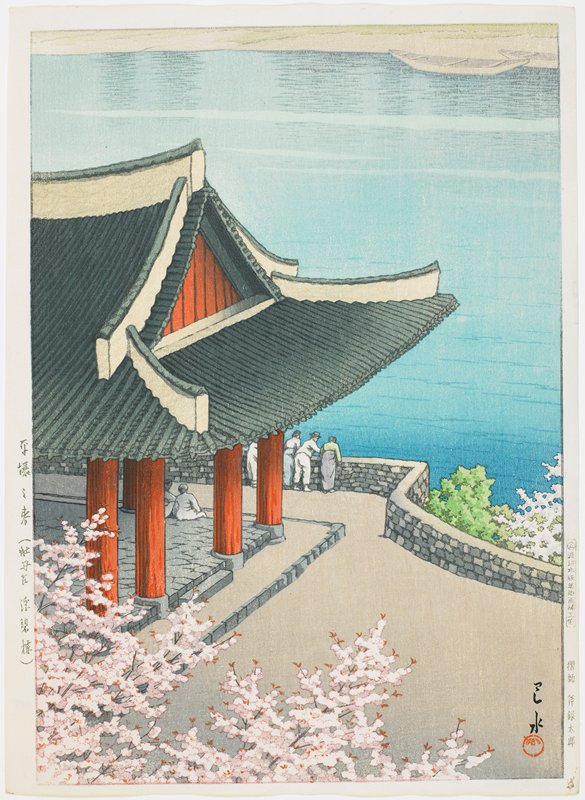
The title pairs two motifs that recur across Yumeji's seasonal imagery — spring (haru) and the twilight or night scene (yoru) — suggesting a composition organized around mood and light rather than narrative event. The image likely depicts a woman in a lantern-lit interior, a quiet street under cherry blossoms, or a riverside view at dusk, with bokashi gradations rendering the deep indigo-violet transition of the evening sky. Spring evenings carry literary resonance in classical Japanese poetry, where the haru no yoi of waka and haiku tradition is associated with quiet melancholy, and Yumeji — himself a published poet whose verses were set to music as Taisho-era songs — drew frequently on this poetic vocabulary when assigning titles. The print would display his preference for emotional atmosphere over topographic specificity, with the figure, if present, functioning less as a portrait subject than as a vehicle for the season's affective register: the gentle melancholy of a springtime dusk.
More Prints by Takehisa Yumeji

More Spring Prints

Frequently Asked Questions
Spring evening was created by Takehisa Yumeji (竹久夢二).
Spring evening depicts spring and night scenes.