
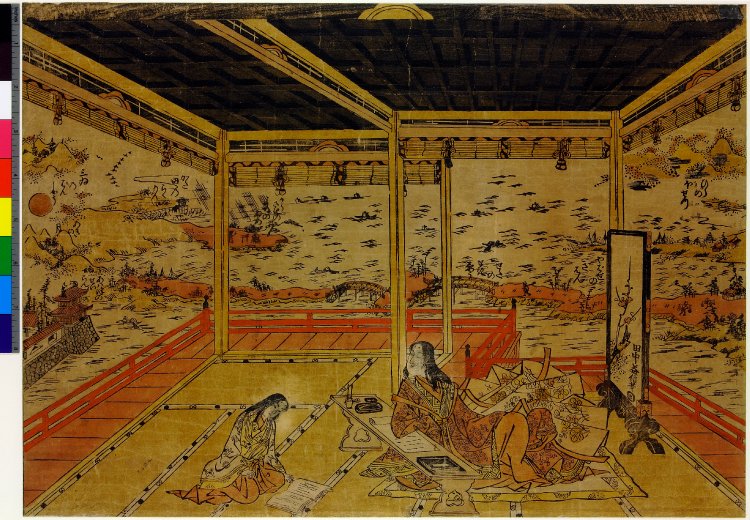
Courtesan Arranging Flowers with Sleeping Kamuro
- Date:
- c. 1740-1750
- Medium:
- Hand-colored woodblock print
- Source:
- British Museum
Description
Held in the British Museum (accession 1906,1220,0.40) and dated to circa 1740-1750, Courtesan Arranging Flowers with Sleeping Kamuro is a hand-coloured woodblock print that captures a quiet domestic moment within the Shin Yoshiwara pleasure quarter. The composition centres on a tayū-rank courtesan arranging cut flowers in a bamboo wall-mounted vase, while her young kamuro attendant lies asleep at her feet — a deliberately reflective scene that places the courtesan in the role of the contemplative arranger rather than the social entertainer. The print belongs to the bijinga (pictures of beautiful women) genre that dominated Tanaka Masunobu's surviving output, and its hand-coloured execution is typical of the beni-e mode of the 1730s and 1740s, in which a single key-block was printed in black ink and the colour applied by hand with the rose-pink beni pigment derived from safflower alongside other mineral pigments. The compositional vocabulary — the elegantly attenuated standing figure, the precisely rendered interior architecture, the contrast between the wakeful courtesan and her sleeping kamuro — reflects the broad early-eighteenth-century Edo bijinga idiom that Okumura Masanobu, Nishikawa Sukenobu, and their contemporaries had developed in the preceding decades. As one of the better-preserved Masunobu prints in a Western collection, the British Museum sheet provides a strong document of his engagement with the intimate, atmospheric Yoshiwara scenes that were a mainstay of the mid-eighteenth-century Edo print market.
More Prints by Tanaka Masunobu
More Birds & Flowers Prints
Frequently Asked Questions
Courtesan Arranging Flowers with Sleeping Kamuro was created by Tanaka Masunobu (田中益信) in c. 1740-1750.
Courtesan Arranging Flowers with Sleeping Kamuro depicts birds & flowers.