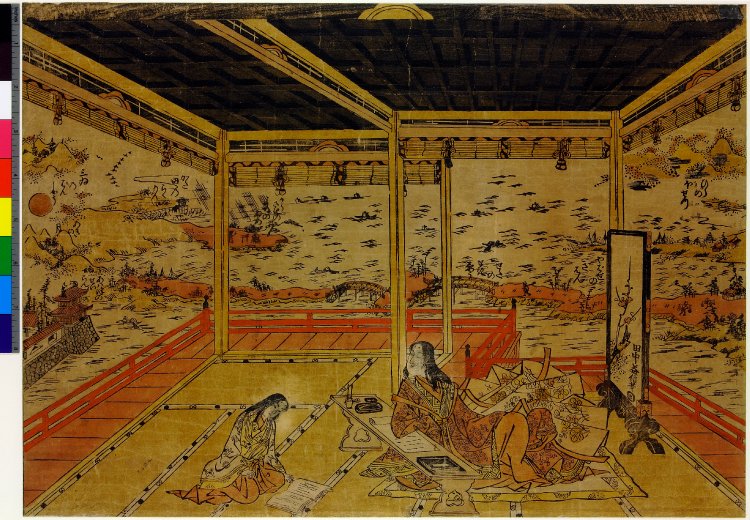
Murasaki Shikibu at Ishiyama Temple with Eight Views of Lake Biwa (uki-e)
- Date:
- c. 1744-1748
- Medium:
- Hand-colored woodblock print (uki-e, perspective print)
- Source:
- British Museum
Description
Held in the British Museum (accession 1906,1220,0.39) and dated to circa 1744-1748, Murasaki Shikibu at Ishiyama Temple with Eight Views of Lake Biwa is an uki-e (perspective picture) hand-coloured woodblock print that combines a classical literary subject with the early-eighteenth-century Edo experiment in Western-derived one-point perspective. The subject is among the most resonant in Heian literary iconography: the Heian-period writer Murasaki Shikibu, traditionally said to have begun composing The Tale of Genji at Ishiyama Temple on the southern shore of Lake Biwa while watching the full moon rise over the lake. The composition arranges the temple interior and its surrounding landscape across the sheet in the uki-e perspective format that Okumura Masanobu had pioneered in the 1740s, with the eight famous views of Lake Biwa (Ōmi hakkei) — the temple bell at Mii, the night rain at Karasaki, the returning sails at Yabase, the autumn moon at Ishiyama, and their companion scenes — integrated into the landscape. The print is a key example of Tanaka Masunobu's engagement with the uki-e format that connects him to the Okumura Masanobu circle, and it documents the way mid-eighteenth-century Edo print designers used the new perspective vocabulary to renew classical literary subjects. The hand-colouring follows the beni-e mode characteristic of the mid 1740s, and the British Museum sheet stands as one of the strongest surviving documents of Masunobu's mature compositional ambition.
More Prints by Tanaka Masunobu

Frequently Asked Questions
Murasaki Shikibu at Ishiyama Temple with Eight Views of Lake Biwa (uki-e) was created by Tanaka Masunobu (田中益信) in c. 1744-1748.