
Benito
- Date:
- 1928
- Medium:
- Etching on cream laid paper
- Source:
- Art Institute of Chicago
Description
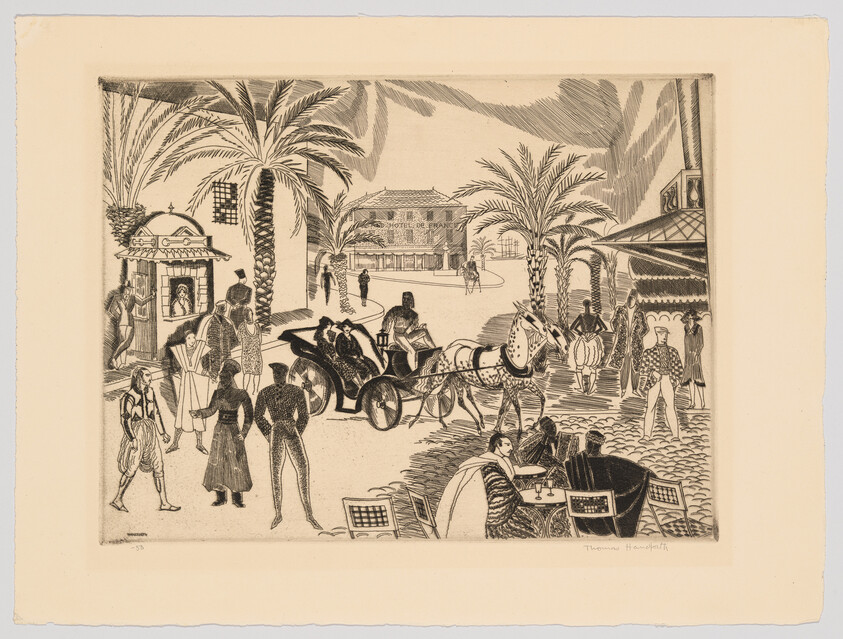
Benito, etched by Thomas Handforth in 1928, is one of the artist's most direct single-figure portraits from his late-1920s Mexican period and gives a face and a name to the wider cast of villagers, market porters, and labourers who populate his prints from the years he spent in the country. The composition concentrates on a single male sitter, shown half-length or full-length depending on the impression, dressed in the work clothes and broad-brimmed straw hat of rural southern Mexico; the etched line is firm and economical, with the figure's character carried by the careful description of face, hands, and the angle of the body. The print's restraint — a single named individual rather than an anonymous group — places it in the tradition of European portrait etching from Rembrandt forward, while its specifically Mexican subject and the post-revolutionary moment in which it was made align it with the wider American interest in serious portrayals of Mexican workers and indigenous communities that ran through the 1920s and 1930s. The Art Institute of Chicago, which holds this impression (https://www.artic.edu/artworks/70345), accessioned Benito as part of its coherent group of 1928 Handforth etchings on cream laid paper. For collectors of Thomas Handforth and for students of American interwar travel printmaking, Benito is significant as a small but psychologically attentive portrait that contradicts the sometimes lazy assumption that observational travel etching tends toward type rather than individual: here the artist gives us a particular man, in a particular place, at a particular moment in his life.
More Prints by Thomas Handforth


Frequently Asked Questions
Benito was created by Thomas Handforth in 1928.