
Casablanca Fort
- Date:
- 1928
- Medium:
- Etching on cream laid paper
- Source:
- Art Institute of Chicago
Description
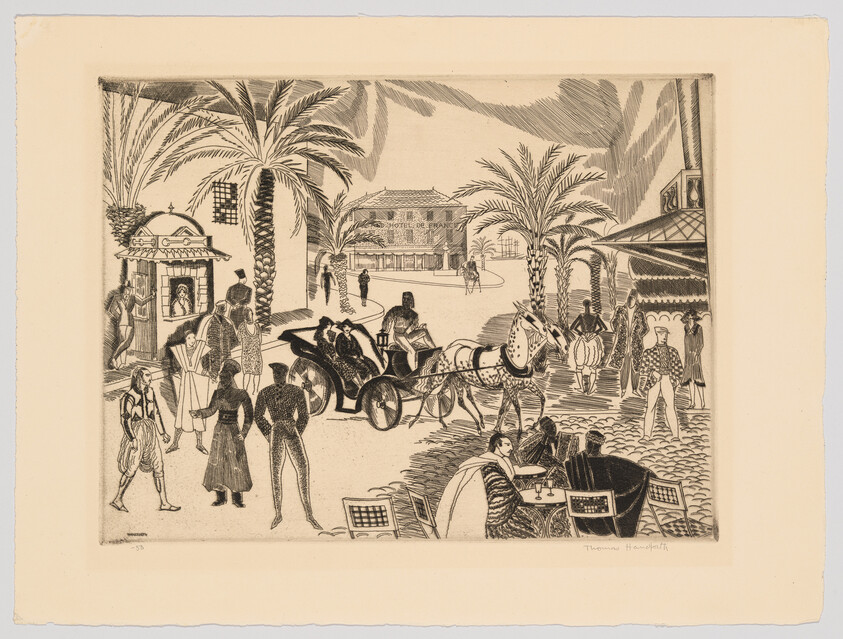
Casablanca Fort, etched by Thomas Handforth in 1928, is one of the artist's earliest fully realised North African subjects and was drawn from his residence in Morocco in the mid-1920s. The composition centres on the massive, sun-bleached masonry of one of Casablanca's older defensive structures, with figures placed at the base of the wall to give scale and to anchor the architectural drama. Handforth's etched line catches the textured weathering of the stone in dense, slightly knotted passages of hatching, while the figures and the sky are handled with much greater economy. The print's debt to the European intaglio tradition of architectural etching — particularly the nineteenth-century French and English schools that had taken the towns of the Mediterranean and North Africa as a major subject — is clear, but Handforth declines to romanticise the fort or its surroundings; the resulting sheet has the workmanlike, observed quality that he would shortly carry to the streets of Peking. The Art Institute of Chicago holds this impression (https://www.artic.edu/artworks/70351) as part of its consistent group of 1928 Handforth etchings on cream laid paper. For students of Thomas Handforth, Casablanca Fort is significant as evidence of how thoroughly his observational manner was already in place by 1928, and as one of the foundational prints of his North African period alongside the related Sfax sheets in the Smithsonian American Art Museum and the Whitney Museum of American Art.
More Prints by Thomas Handforth


Frequently Asked Questions
Casablanca Fort was created by Thomas Handforth in 1928.