
Pulque y Tortilla
- Date:
- 1928
- Medium:
- Etching on cream laid paper
- Source:
- Art Institute of Chicago
Description
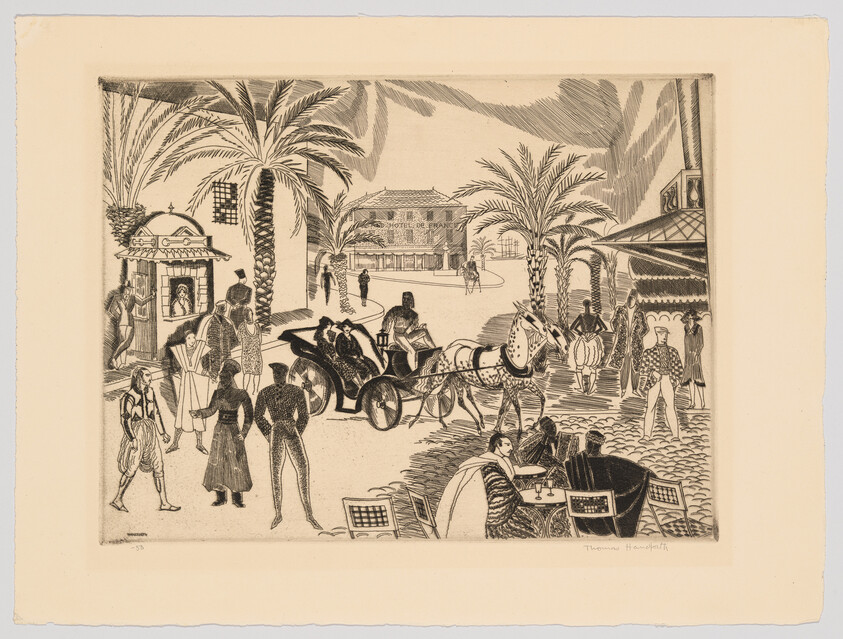
Pulque y Tortilla, etched by Thomas Handforth in 1928, is one of the most directly social prints from the artist's Mexican period and turns its etched eye on the staples of village life that gave the print its title: pulque, the fermented agave drink that has been central to central Mexican rural culture since pre-conquest times, and tortillas, the corn flatbread that is the everyday foundation of the Mexican diet. The composition is built around a small group of villagers gathered around the food and drink, with the surrounding environment indicated through looser passages of etched hatching. The print belongs to the coherent group of 1928 Mexican subjects — Tierra Caliente, Benito, The Bride (Francesca) — that established Handforth among American etchers seriously engaged with post-revolutionary Mexican daily life, and it can be read alongside the better-known Mexican prints of Howard Cook, Pablo O'Higgins, and the Taller de Gráfica Popular as evidence of the wider American cultural traffic with Mexico in the 1920s and 1930s. The Art Institute of Chicago holds this impression (https://www.artic.edu/artworks/70344) and documents it among the consistent Handforth holding acquired through Mrs. Merle Shera. For collectors of interwar American etching, Pulque y Tortilla is significant for the seriousness with which it treats its subject — a meal, a drink, an ordinary gathering — without exoticising the sitters, and for the directness of Handforth's etched description of a working-class Mexican social scene.
More Prints by Thomas Handforth


Frequently Asked Questions
Pulque y Tortilla was created by Thomas Handforth in 1928.