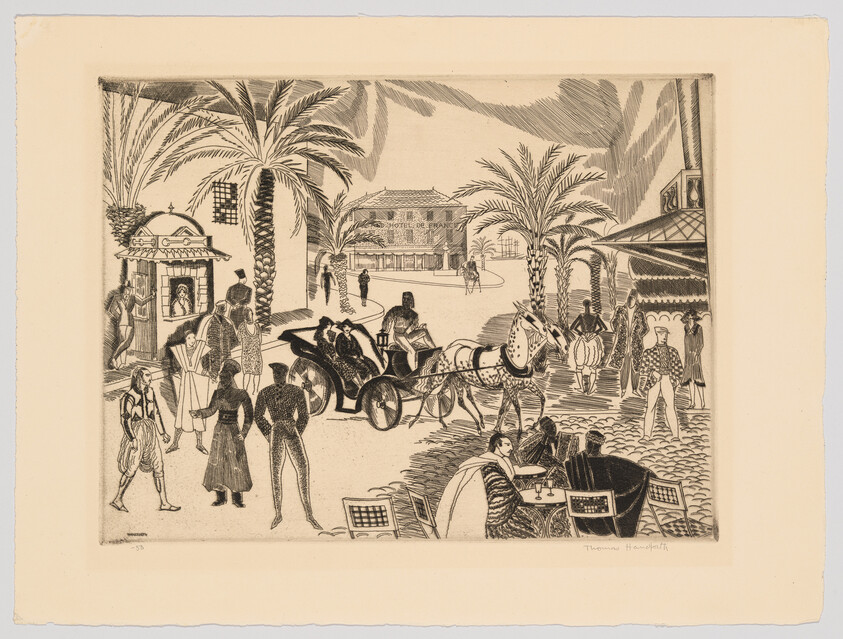
Sfax, Tunis
- Date:
- n.d.
- Medium:
- Etching on paper
- Source:
- Smithsonian American Art Museum
Description
Sfax, Tunis, an undated etching by Thomas Handforth held at the Smithsonian American Art Museum, is among the artist's most fully developed North African subjects and an indispensable companion to the Whitney Museum's related Sfax print. The composition is set in the Tunisian port city whose name it carries; figures, horses, carriages, and the characteristic palm trees and low whitewashed architecture of the southern Tunisian coast move across the sheet in a loose, observed group. Handforth's etched line catches the sunlit, slightly hazy quality of the North African coastal light: the figures and animals are built from a small number of decisive strokes, while the architecture and trees are handled with looser hatching that leaves the paper open to suggest heat and atmosphere. The print belongs to the artist's North African period in the mid-1920s, when he travelled extensively in Morocco and Tunisia before settling on Mexico and, eventually, China as his primary expatriate bases, and is a clear example of his observational rather than picturesque treatment of foreign subject matter. The Smithsonian American Art Museum records the print under accession number 1966.97.1, acquired by museum purchase, and provides open access to a high-resolution image through the Smithsonian's Open Access programme (https://americanart.si.edu/artwork/sfax-tunis-9917). For collectors of Thomas Handforth and for students of American interwar travel printmaking, Sfax, Tunis is one of the central sheets of his North African period and a useful counterpart to the better-known Peking and Mexican prints that followed.
More Prints by Thomas Handforth


Frequently Asked Questions
Sfax, Tunis was created by Thomas Handforth in n.d..