
Enoshima, from the series "Mount Fuji in the Four Seasons (Shiki no Fuji)"
- Date:
- c. 1785
- Medium:
- Color woodblock print; chuban
- Source:
- Art Institute of Chicago
Description
Torii Kiyonaga's Enoshima, from the series Mount Fuji in the Four Seasons (Shiki no Fuji), dates to about 1780 and is held by the Art Institute of Chicago. The series treats Mount Fuji as a constant presence behind a sequence of famous places, and the Enoshima sheet pairs the sacred island of Sagami Bay - with its causeway exposed at low tide - against the unmistakable silhouette of the mountain on the horizon. Kiyonaga's figures stroll across the wide beach toward the shrine, their tall, graceful proportions and clean contours bringing the conventions of his Edo bijin-ga into a panoramic landscape. By 1780 he was the leading designer of the Torii school, and Mount Fuji in the Four Seasons shows him adapting the workshop's compositional confidence - built on theater signboards and group scenes - to a broad outdoor format. The print emphasizes a few horizontal bands: the firm line of the strand, the soft tide, the distant hills, and finally Fuji itself, while the figures provide vertical accents that read clearly even from a distance. Block printing in restrained color allows the topography to remain legible while keeping fashion details on the travelers crisp. As one of Kiyonaga's contributions to the landscape-with-figures tradition, the sheet records his ability to balance famous-place subject matter with the calm bearing of his beauties, and its place in the Art Institute of Chicago confirms its standing within his Torii school landscape work.
More Prints by Torii Kiyonaga

Watching the Water Festival from Azuma Bridge, from the series "Eight Precincts of the Kinryuzan Temple in Asakusa (Asakusa Kinruzan hakkei)"
c. 1782
Color woodblock print; chuban

Courtesans of Yoshiwara and their attendants viewing the peonies on Nakanocho
c. 1787
Color woodblock print; center and right sheets of oban triptych

A visit to a shrine, from the series "Twelve Scenes of Popular Customs (Fuzoku juni tsui)"
c. 1786
Color woodblock print; koban

A Party Viewing the Moon Across the Sumida River
c. 1787
Color woodblock print; oban triptych
More Mount Fuji Prints
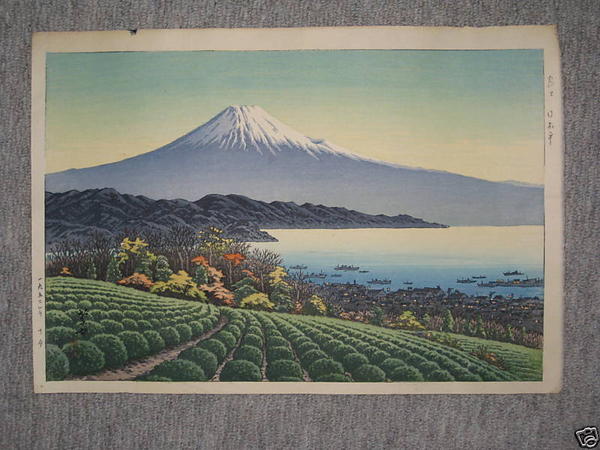
Fuji from tea farm
Woodblock print

Akasaka, Fujikawa, Okazaki, Chiryu, and Narumi, from the series "Famous Places on the Fifty-three Stations of the Tokaido, Five Stations (Tokaido gojusan eki goshuku meisho)"
c. 1830/35
Color woodblock print; oban
![Mount Fuji on a Moonlit Night, Kawai Bridge (Tsukiyo no Fuji [Kawaibashi]), from the series "Selection of Views of the Tokaido (Tokaido fukei senshu)" by Kawase Hasui](https://www.artic.edu/iiif/2/d0960668-1e73-339a-b182-fb995a54bff0/full/843,/0/default.jpg)
Mount Fuji on a Moonlit Night, Kawai Bridge (Tsukiyo no Fuji [Kawaibashi]), from the series "Selection of Views of the Tokaido (Tokaido fukei senshu)"
1947
Color woodblock print; oban

Mt. Fuji in Rain (Ame no Fuji)
n.d.
Color woodblock print
Featured in Collections
Curated cross-cuts that include this print.
Frequently Asked Questions
Enoshima, from the series "Mount Fuji in the Four Seasons (Shiki no Fuji)" was created by Torii Kiyonaga (鳥居清長) in c. 1785.
Enoshima, from the series "Mount Fuji in the Four Seasons (Shiki no Fuji)" depicts mount fuji.