
The Actors Otani Oniji I as Soga no Goro and Sanogawa Ichimatsu I as the sister of Yoshinaka in the play "Fuji no Yuki Mitsugi Soga," performed at the Nakamura Theater in the first month, 1746
- Date:
- 1746
- Medium:
- Color woodblock print; hosoban, benizuri-e
- Source:
- Art Institute of Chicago
Description
The Actors Otani Oniji I as Soga no Goro and Sanogawa Ichimatsu I as the sister of Yoshinaka in the play Fuji no Yuki Mitsugi Soga, performed at the Nakamura Theater in the first month, 1746, documents a Soga-cycle New Year program at the Nakamuraza in which a leading aragoto specialist paired with the celebrated fashionable Ichimatsu in a cross-narrative production that combined the Soga vendetta material with reference to the Minamoto no Yoshinaka Kiso branch of the Genpei conflict. Otani Oniji I, a male-role actor working in the muscular aragoto register that the Ichikawa Danjuro line had codified, takes the role of Soga no Goro Tokimune, the younger vendetta brother whose impassioned youthful fury drives the cycle's emotional intensity; Sanogawa Ichimatsu I, the celebrated wakashugata whose checkered textile pattern had become an emblem of Edo style, appears in the female role of Yoshinaka's sister, the casting of the famous male-role actor in a cross-gender role belonging to a familiar Edo kabuki convention. The Fuji no Yuki Mitsugi Soga title invokes the snow-clad peak of Mount Fuji that loomed over the historical Soga vendetta site at its foot. Torii Kiyonobu I, founder of the Torii school of yakusha-e, draws the two standing figures in the disciplined bold contour he had codified for sumizuri-e production, with the muscular hyotan-ashi mimizu-gaki line giving Soga no Goro his aragoto weight against the lightly inked ground. The hosoban or wide-bordered tate-e format frames the paired figures, with patterned costume motifs supplying the principal visual interest. As founder of the Torii yakusha-e tradition, Kiyonobu produced such commemorative dual portraits in direct service to the kabuki houses. The Art Institute of Chicago preserves this impression (source_url https://www.artic.edu/artworks/19257) as a record of the 1746 Nakamuraza Soga New Year production in the founding Torii hand.
More Prints by Torii Kiyonobu I

A Courtesan with Her Child Attendant
c. 1715
Woodblock print; o-oban, sumizuri-e

The actor Yamanaka Heikuro I as a demon
c. 1706
Woodblock print; hosoban, sumizuri-e

The Actor Shinomiya Heihachi I
c. 1703
Hand-colored woodblock print; hosoban, tan-e

A Professional Baffoon, from a untitled series of 12 prints
c. 1710
Woodblock print; oban, sumizuri-e
More Mount Fuji Prints
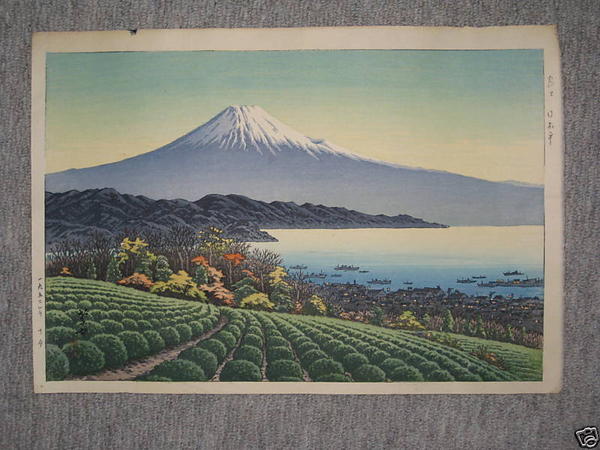
Fuji from tea farm
Woodblock print

Akasaka, Fujikawa, Okazaki, Chiryu, and Narumi, from the series "Famous Places on the Fifty-three Stations of the Tokaido, Five Stations (Tokaido gojusan eki goshuku meisho)"
c. 1830/35
Color woodblock print; oban
![Mount Fuji on a Moonlit Night, Kawai Bridge (Tsukiyo no Fuji [Kawaibashi]), from the series "Selection of Views of the Tokaido (Tokaido fukei senshu)" by Kawase Hasui](https://www.artic.edu/iiif/2/d0960668-1e73-339a-b182-fb995a54bff0/full/843,/0/default.jpg)
Mount Fuji on a Moonlit Night, Kawai Bridge (Tsukiyo no Fuji [Kawaibashi]), from the series "Selection of Views of the Tokaido (Tokaido fukei senshu)"
1947
Color woodblock print; oban

Mt. Fuji in Rain (Ame no Fuji)
n.d.
Color woodblock print
Featured in Collections
Curated cross-cuts that include this print.
Frequently Asked Questions
The Actors Otani Oniji I as Soga no Goro and Sanogawa Ichimatsu I as the sister of Yoshinaka in the play "Fuji no Yuki Mitsugi Soga," performed at the Nakamura Theater in the first month, 1746 was created by Torii Kiyonobu I (鳥居清信) in 1746.
The Actors Otani Oniji I as Soga no Goro and Sanogawa Ichimatsu I as the sister of Yoshinaka in the play "Fuji no Yuki Mitsugi Soga," performed at the Nakamura Theater in the first month, 1746 depicts mount fuji.