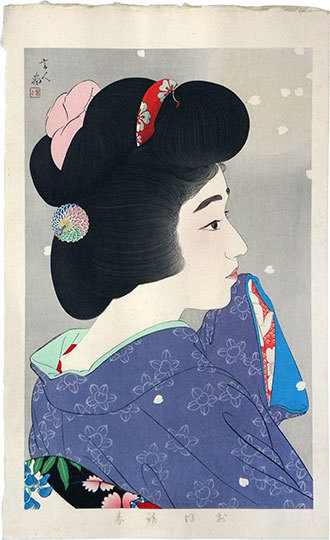
Hazy Moon in the Spring (Oboroharu)
- Date:
- 1930
- Medium:
- Woodblock print
- Format:
- Oban
- Publisher:
- Watanabe Shozaburo
- Edition:
- Published by Watanabe Shozaburo
- Source:
- Scholten Japanese Art
Description
A woman stands in the hazy moonlight of a spring night — Oboroharu, the "misty spring," a season-word (kigo) from haiku tradition evoking the particular soft indistinctness of spring evenings when the moon is veiled. Kotondo renders this atmosphere through bokashi gradations that suffuse the composition in pale, diffuse light. The woman's face tilts slightly upward, as though absorbing the moonlit air — a posture of quiet receptivity that places her within rather than apart from the atmospheric scene.
More Prints by Torii Kotondo

More Spring Prints

Featured in Collections
Curated cross-cuts that include this print.
Frequently Asked Questions
Hazy Moon in the Spring (Oboroharu) was created by Torii Kotondo (鳥居言人) in 1930.
Hazy Moon in the Spring (Oboroharu) uses Bokashi, on woodblock print.
Hazy Moon in the Spring (Oboroharu) was published by Watanabe Shozaburo (1930).
Hazy Moon in the Spring (Oboroharu) depicts spring, moonlight, and night scenes.