
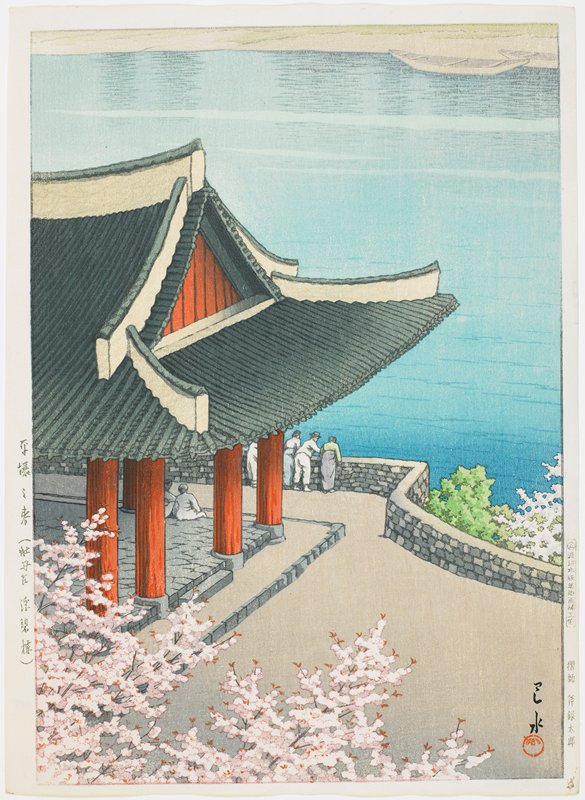
Misty Spring (Oboro Haru)
- Source:
- ukiyo-e.org
Description
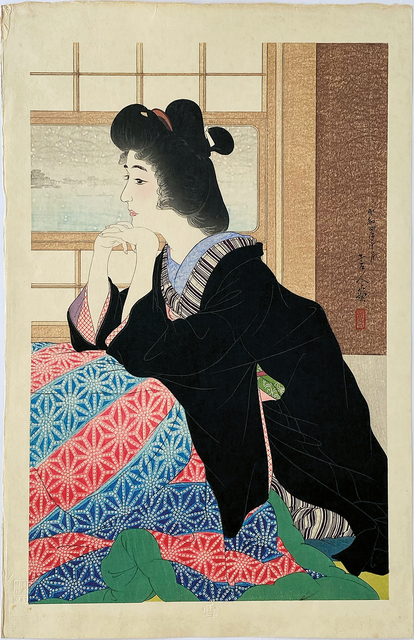
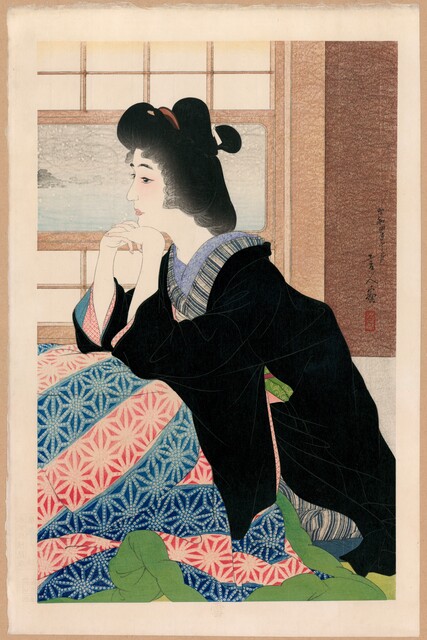
Misty Spring (Oboro Haru) is one of the lyrical seasonal designs by Torii Kotondo that show how thoroughly he adapted the Torii school bijin-ga tradition to the visual language of shin-hanga. Kotondo, born Akiyoshi Saito in 1900 and adopted into the Torii line as its seventh-generation head, produced only a small number of prints — fewer than two dozen mature designs — but each was developed with extraordinary care under publishers Sakai and Ikeda. The Japanese term oboro evokes the hazy, moisture-laden atmosphere of early spring nights when the moon is veiled and edges soften, and Kotondo translates that atmosphere through diffused color fields, restrained outline, and the tender posture of a young woman absorbed in her own reverie. The blockwork combines the linear discipline inherited from generations of Torii draftsmen with the tonal printing innovations championed by shin-hanga publisher Watanabe Shozaburo and his contemporaries — bokashi gradations, mica or pearlescent grounds, and pigment layers built up impression by impression. Indexed through ukiyo-e.org from the John Fiorillo / Viewing Japanese Prints archive, this design joins Kotondo's better-known studies of women combing their hair or applying rouge in articulating a private, seasonal mood rather than a public spectacle. Misty Spring stands as a quiet rebuttal to the assumption that bijin-ga is decorative: in Kotondo's hands the genre becomes a study of interior weather, where mist, moon, and the contour of a kimono together describe a particular hour in a particular season.
More Prints by Torii Kotondo

More Spring Prints

Featured in Collections
Curated cross-cuts that include this print.
Frequently Asked Questions
Misty Spring (Oboro Haru) was created by Torii Kotondo (鳥居言人).
Misty Spring (Oboro Haru) depicts spring.