
Portrait-Icon of Murasaki Shikibu
- Date:
- 17th century
- Medium:
- Hanging scroll; ink, color, and gold on silk
Description
A devotional hanging-scroll painting by Tosa Mitsuoki depicting Murasaki Shikibu (c. 973-1014?), the Heian-period author of The Tale of Genji - widely considered the greatest work of classical Japanese literature and one of the foundational novels of world literature. Murasaki Shikibu is shown in the courtly costume of the Heian period, typically with writing implements at hand and with the round Japanese pictorial features (hikime-kagibana, the line-eyes and hook-nose convention) that Tosa-school painters used to render courtly faces. By legend the author began composing The Tale of Genji at Ishiyama-dera, the temple on the southern shore of Lake Biwa where she had retreated during the autumn moon-viewing season; the temple preserves a chamber known as the Genji-no-ma where she is said to have written the opening of the novel, and the temple's holding of this Tosa-Mitsuoki portrait-icon links the painting directly to the legendary site of the novel's composition. The painting belongs to the seventeenth century - the period of Mitsuoki's mature work in Kyoto - and is preserved at Ishiyama-dera. As a portrait-icon (zo) it functioned both as devotional image and as a memorial of the author whose work was central to Japanese literary identity, and it stands as one of the canonical portraits of Murasaki in the Japanese visual tradition. The image is widely reproduced and accessible via Wikimedia Commons.
More Prints by Tosa Mitsuoki

Quail and Autumn Flowers
second half of 17th century
Hanging scroll; ink and color on silk
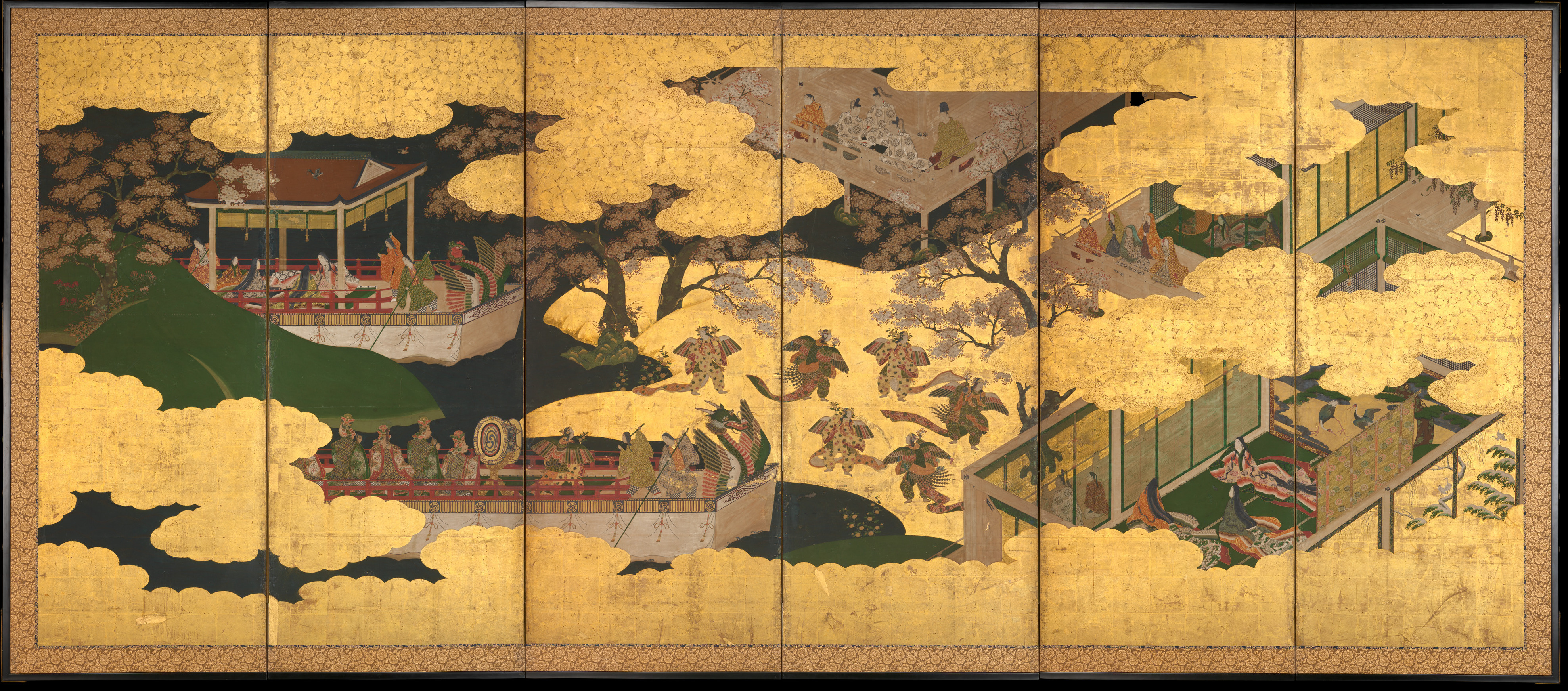
Butterflies
second half of 17th century
Pair of six-panel folding screens; ink, color, and gold on silk

Heron
second half of 17th century
Hanging scroll; ink and color on silk

Flowering Cherry and Autumn Maples with Poem Slips
1654/81
Pair of six-panel screens; ink, color, gold and silver on silk
Frequently Asked Questions
Portrait-Icon of Murasaki Shikibu was created by Tosa Mitsuoki (土佐光起) in 17th century.