
Tosa Mitsuoki
土佐光起
1617–1691
Japan
Biography
Tosa Mitsuoki (土佐光起, 1617-1691) was the painter who restored the Tosa school - the imperial atelier of yamato-e, the classical Japanese pictorial tradition - to official standing at the Kyoto court after nearly a century of dormancy. Born in Sakai, into a branch of the Tosa lineage that had relocated there in the late sixteenth century, he moved to Kyoto as a young man and devoted his career to reviving the family's historic claim to the directorship of the imperial Office of Painting (edokoro azukari), an institutional role the Tosa house had held in the Muromachi period before losing it to the rival Kano school in the turbulence of the late sixteenth century.
The Tosa school traced its lineage to the late fourteenth century and had codified the yamato-e tradition - native Japanese painting, distinguished from the Chinese-derived (kara-e) styles that dominated medieval Japanese ink painting - around classical literary subjects: scenes from The Tale of Genji, the Ise monogatari, the Genji and Heike narrative scrolls, the four seasons, and the calendar of Heian courtly life. The school's hallmarks were a brilliant decorative palette of mineral pigments, the use of gold leaf and silver leaf for atmospheric and architectural effects, the tsukurie technique of carefully built-up colored layers over a precise ink underdrawing, the hikime-kagibana (line-eyes and hook-nose) convention for rendering courtly faces, and a strong commitment to the classical canon of Japanese subject matter. Mitsuoki's father, Tosa Mitsunori (1583-1638), had maintained the family practice in Sakai through difficult years; Mitsuoki inherited the workshop in 1638 and within two decades had returned the Tosa name to its historic preeminence at court.
In 1654 Mitsuoki was appointed edokoro azukari, the head of the imperial Office of Painting, a position the Tosa house had not held since the death of Tosa Mitsumoto in 1569, nearly a century earlier. The appointment formally restored the Tosa lineage to its traditional position as the painters of the imperial court, and Mitsuoki used the platform to consolidate the school's institutional standing through teaching, commissions for the imperial household, and large-scale screen and scroll painting for aristocratic and temple patrons. His work belonged to the seventeenth-century revival of court culture under Emperor Go-Mizunoo, at whose behest the Tosa house had returned to Kyoto.
Mitsuoki's mature style refined the Tosa decorative vocabulary into one of its most lyrical phases. His pair of six-panel screens Flowering Cherry and Autumn Maples with Poem Slips (Art Institute of Chicago) exemplifies his approach: the spring cherry tree and the autumn maple are shown each on its own screen, the branches densely hung with paper poem slips (tanzaku) inscribed with classical waka, the ground washed with gold to give the trees and slips an atmospheric depth that placed Heian poetic culture in a continuous decorative present.
Beyond the screen format Mitsuoki produced hanging-scroll paintings of bird-and-flower subjects (his Heron and Egrets and Cotton Roses at the Metropolitan Museum of Art), portraits of the canonical Japanese poets (the Portraits of Three Famous Poets: Hitomaro, Ise, and Komachi at the Met, a triptych he painted together with his son and grandson), and devotional paintings such as the Portrait-Icon of Murasaki Shikibu at Ishiyama-dera, depicting the eleventh-century author of The Tale of Genji at the temple where, by legend, she began writing her novel. The wide range of subjects and formats demonstrates the comprehensive scope of the Tosa-school revival under his leadership: not merely a return to traditional subjects but a thorough re-application of yamato-e methods to the visual culture of the early Edo period imperial court.
Mitsuoki died in Kyoto in 1691, having transmitted the restored Tosa lineage to his son Mitsunari (1646-1710) and his pupils. The school continued under his descendants and disciples - including the related Sumiyoshi branch founded by his contemporary Sumiyoshi Jokei - through the rest of the Edo period, supplying the imperial court with painters into the Meiji era. His surviving works at the Art Institute of Chicago, the Metropolitan Museum of Art, and major Japanese collections preserve the Tosa lineage's seventeenth-century revival as one of the central episodes of early-Edo Japanese painting.
Key Facts
- Active Period
- 1617–1691
- Nationality
- 🇯🇵Japan
- Subjects
- Birds & FlowersAutumn Foliage
- Works Indexed
- 8
Frequently Asked Questions
Tosa Mitsuoki (土佐光起, 1617-1691) was the painter who restored the Tosa school - the imperial atelier of yamato-e, the classical Japanese pictorial tradition - to official standing at the Kyoto court after nearly a century of dormancy. Born in Sakai, into a branch of the Tosa lineage that had relocated there in the late sixteenth century, he moved to Kyoto as a young man and devoted his career to reviving the family's historic claim to the directorship of the imperial Office of Painting (edokoro azukari), an institutional role the Tosa house had held in the Muromachi period before losing it to the rival Kano school in the turbulence of the late sixteenth century.
Tosa Mitsuoki was active from 1617 to 1691.
Tosa Mitsuoki's prints frequently feature birds & flowers, autumn foliage.
Original prints by Tosa Mitsuoki can be found in collections including Metropolitan Museum of Art, Ishiyama-dera (via Wikimedia Commons), Art Institute of Chicago.
Woodblock Prints by Tosa Mitsuoki (8)
Bamboo and Fences
1654/81
One of a pair of six-fold screens; ink and light color on paper

Flowering Cherry and Autumn Maples with Poem Slips
1654/81
Pair of six-panel screens; ink, color, gold and silver on silk
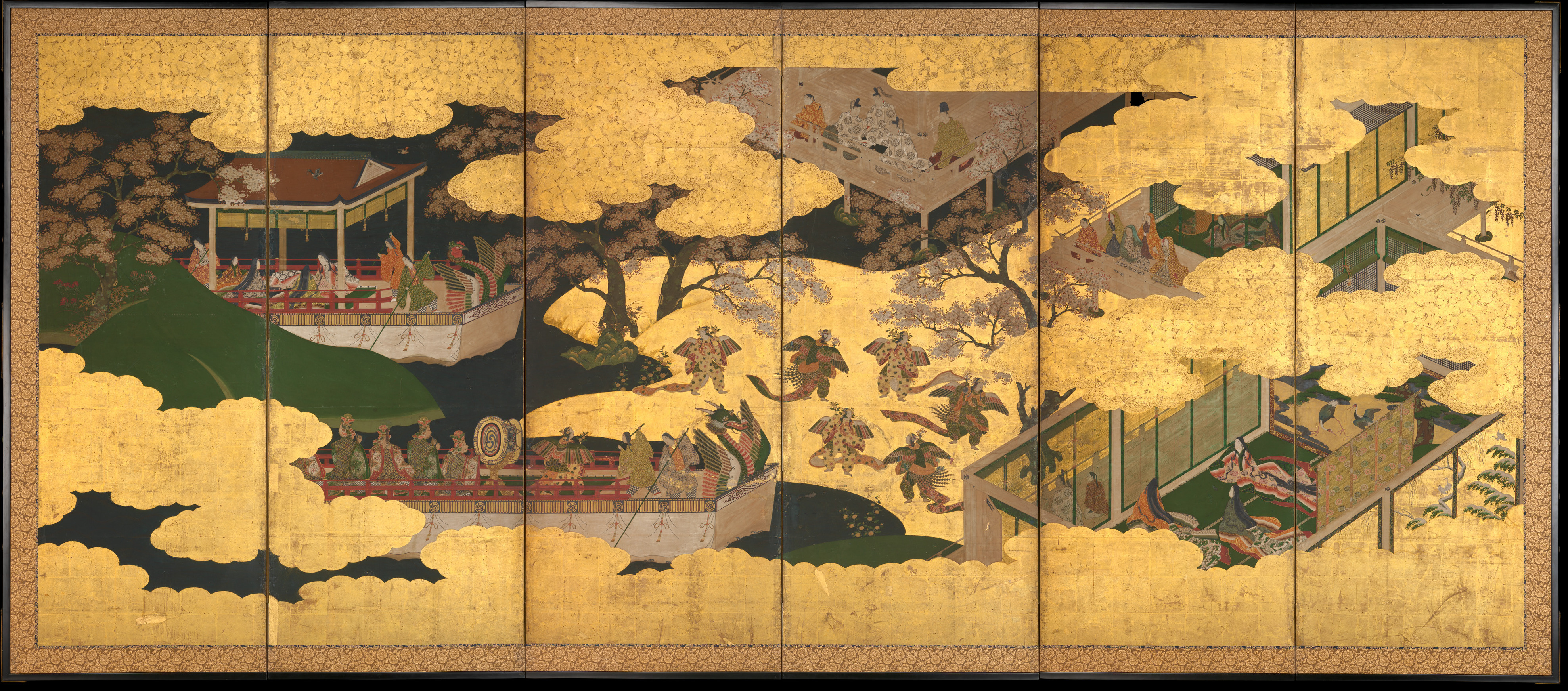
Butterflies
second half of 17th century
Pair of six-panel folding screens; ink, color, and gold on silk

Heron
second half of 17th century
Hanging scroll; ink and color on silk

Egrets and Cotton Roses
second half of 17th century
Hanging scroll; ink, color, and gold on silk

Quail and Autumn Flowers
second half of 17th century
Hanging scroll; ink and color on silk

Portrait-Icon of Murasaki Shikibu
17th century
Hanging scroll; ink, color, and gold on silk

Autumn Maples with Poem Slips
c. 1675
Six-panel screen (one of pair); ink, colors, gold leaf, and gold powder on silk