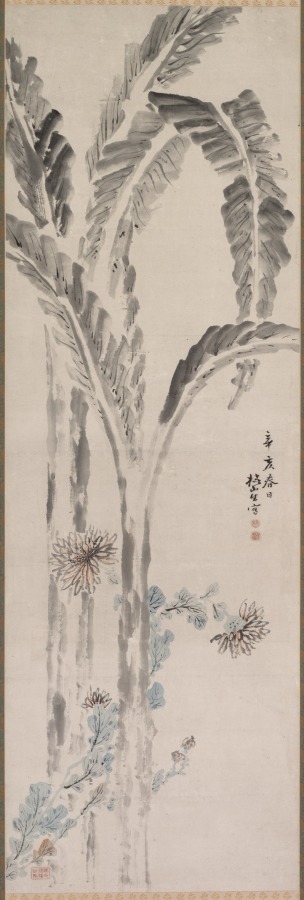
Banana Plant and Chrysanthemum
- Date:
- c. 1820–54
- Medium:
- Hanging scroll; ink and color on paper
- Source:
- Cleveland Museum of Art
Description
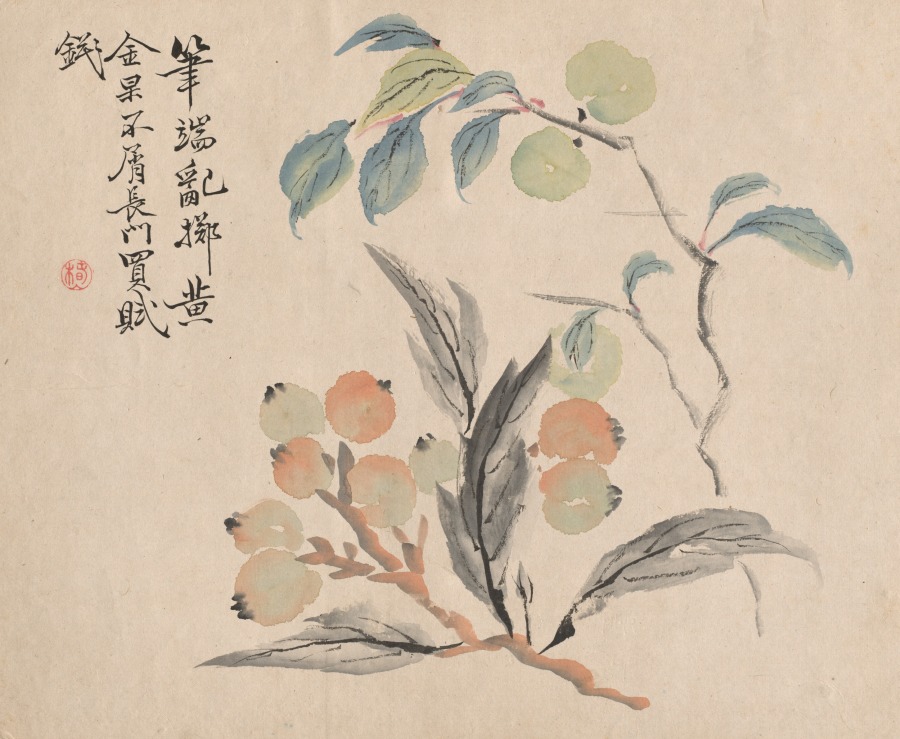
Banana Plant and Chrysanthemum, dated 1837, is a kachō-e by Tsubaki Chinzan (椿椿山, 1801-1854) in the Cleveland Museum of Art (accession 1983.113; https://www.clevelandart.org/art/1983.113). Painted while his teacher Watanabe Kazan (1793-1841) was still alive — and two years before Kazan's arrest in the Bansha no Goku affair of 1839 — the sheet belongs to the formative middle phase of Chinzan's career as a bird-and-flower specialist, the period in which his idiom was still being shaped under his teacher's direct influence. The pairing of the broad-leaved banana plant (bashō) with the autumn chrysanthemum draws on long-standing Chinese literati associations: the banana plant figures in classical poetry as a subject of contemplation in rain and as a surface for inscription (Tang poets famously composed verses on banana leaves), and the chrysanthemum is the canonical scholar's flower of autumn, associated above all with the recluse-poet Tao Yuanming and his celebrated eastern hedge. Combined in a single composition, the two plants assemble a literati emblematic program that any cultivated viewer would have recognized as a meditation on retreat, observation, and seasonal sensibility. As a student of Kazan and a participant in the Tani Bunchō circle, Chinzan worked with a brush trained both on Chinese painting manuals and on the close natural observation that Kazan had absorbed from rangaku scholarship: the banana leaves are treated with broad tonal washes and structural midribs, the chrysanthemum with more precisely modulated linear work and gathered color in the bloom. The combination — botanical attention married to literati iconography — is precisely the synthesis that defines Chinzan's mature kachō-e reputation. The Cleveland source provides the firm attribution and the 1837 date.
More Prints by Tsubaki Chinzan
Frequently Asked Questions
Banana Plant and Chrysanthemum was created by Tsubaki Chinzan (椿椿山) in c. 1820–54.