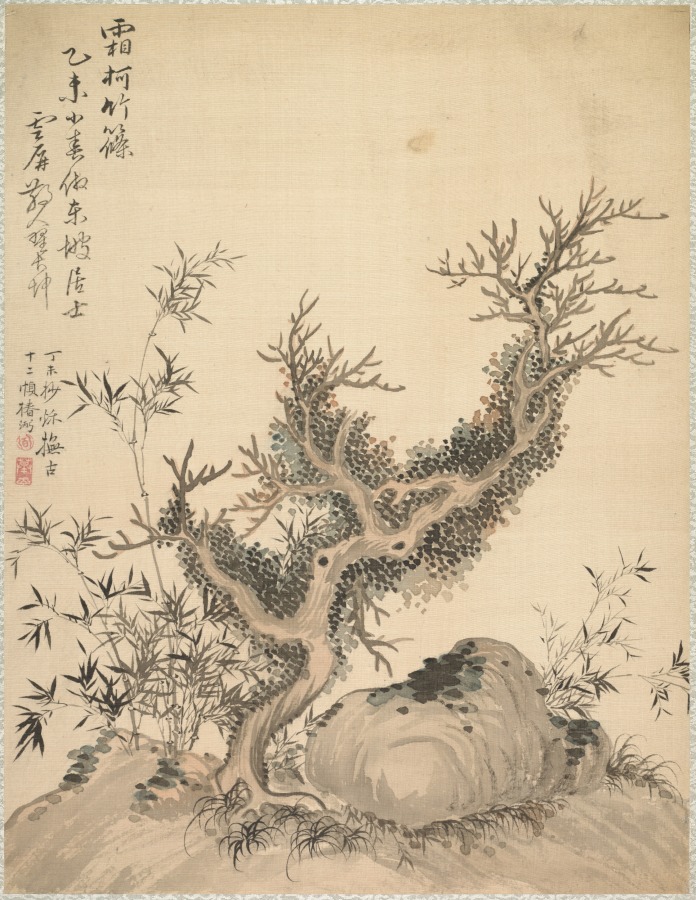
Frosted Branches and Dwarf Bamboo
- Date:
- 1847
- Medium:
- Album leaf; ink and color on silk
- Source:
- Cleveland Museum of Art
Description
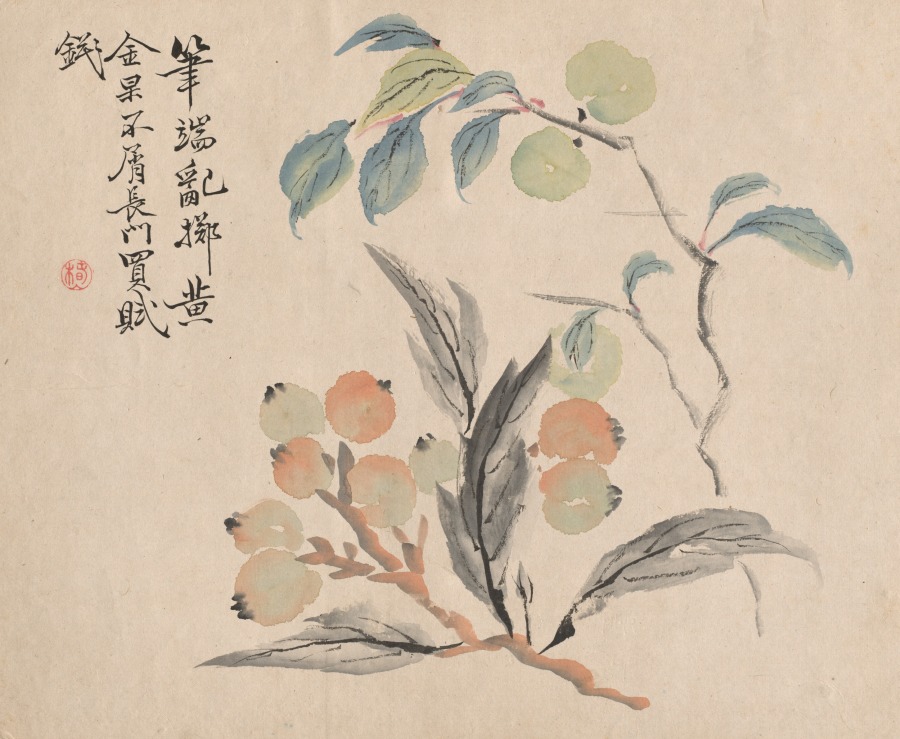
Frosted Branches and Dwarf Bamboo, dated 1847, is a leaf by Tsubaki Chinzan (椿椿山, 1801-1854) in the Cleveland Museum of Art (accession 1985.251.10; https://www.clevelandart.org/art/1985.251.10), part of the museum's related 1847 ensemble (accessions 1985.251.1-10). Although Chinzan is most often celebrated for his finished kachō-e, the present leaf demonstrates how readily he moved between landscape and the more intimate floral idiom within a single album-like group. Frost-touched branches and dwarf bamboo (sasa) are classical subjects of East Asian literati painting, associated with winter rectitude and the unbending character of the scholar — themes Edo nanga painters absorbed from Chinese painting manuals and from imported Ming and Qing scrolls. Bamboo in particular is the canonical literati subject: from the Song scholar-painter Wen Tong onward, monochrome bamboo had been understood as a painted form of calligraphy and as a moral emblem of the cultivated mind. Frost and rime add a seasonal layering that recalls the four-gentleman tradition (plum, orchid, bamboo, chrysanthemum) on which late-Ming and Qing literati painters elaborated. As Watanabe Kazan's principal pupil and a leading figure in the Tani Bunchō circle, Chinzan was a connoisseur of this iconography and of the brushwork that carries it: dry-brush passages to suggest the rime of frost on the twigs, sharper modulated strokes to articulate the bamboo blades, restrained color to preserve the wintry mood. The 1847 date situates the leaf within his mature post-Kazan practice, when he was both sustaining his teacher's bunjinga ideals and acting as the chief Edo transmitter of the late-Edo nanga lineage. The Cleveland catalogue supplies the date, attribution, and place within the larger 1985.251 series.
More Prints by Tsubaki Chinzan
Frequently Asked Questions
Frosted Branches and Dwarf Bamboo was created by Tsubaki Chinzan (椿椿山) in 1847.