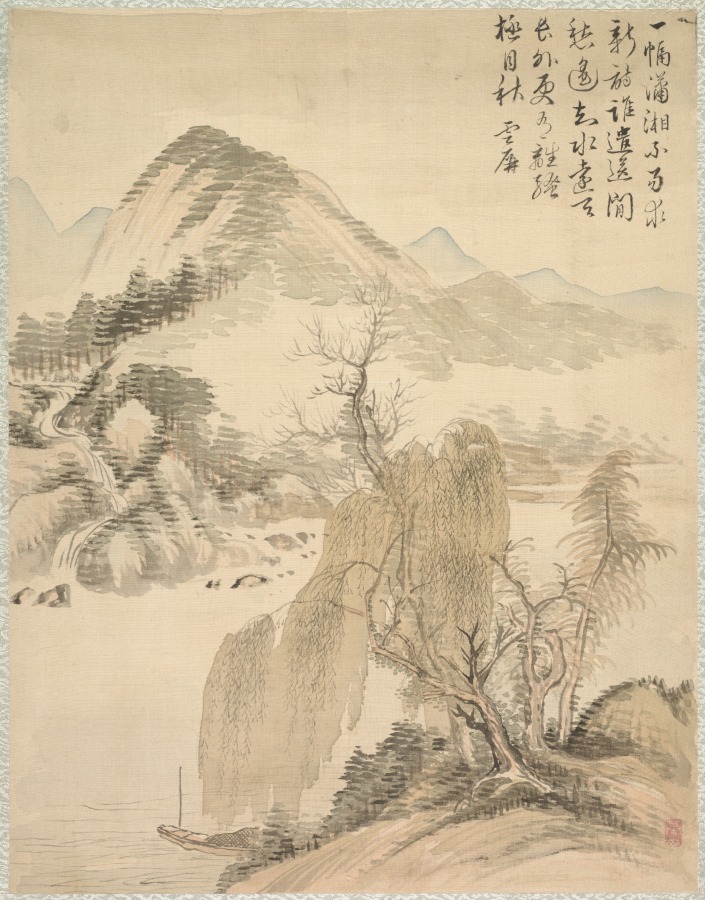
Willow and Waterfall
- Date:
- 1847
- Medium:
- Album leaf; ink and color on silk
- Source:
- Cleveland Museum of Art
Description
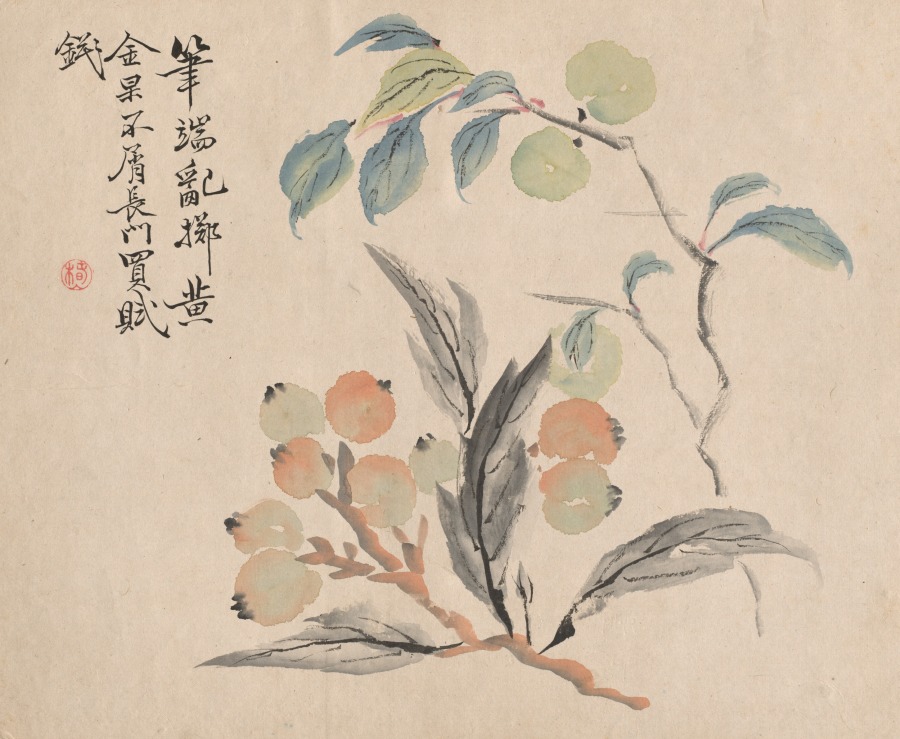
Willow and Waterfall, dated 1847, is an ink-and-color landscape leaf by Tsubaki Chinzan (椿椿山, 1801-1854) in the Cleveland Museum of Art (accession 1985.251.7; https://www.clevelandart.org/art/1985.251.7), part of the related 1847 grouping (accessions 1985.251.1-10). The pairing of a willow with a waterfall is a literati image of doubled motion: the slow downward fall of willow withes against the faster downward fall of water, framed by the rock and ground from which both emerge. Such subjects allowed Edo nanga painters to deploy a range of brush idioms within a single small composition — the loose, drawn-out strokes that describe willow foliage, the firmer texture strokes for the rock face, the fine parallel hatching for the cascade, and the modulated wash that supplies surrounding air. The motif descends from the Chinese landscape tradition in which willows mark riverbanks and waterfalls mark mountain interiors; both belong to the canonical brush exercises through which a scholar-painter demonstrated literacy in the inherited landscape vocabulary. Trained by Watanabe Kazan (1793-1841) and embedded in the Tani Bunchō circle that defined late-Edo bunjinga, Chinzan understood the leaf format as a setting in which literati brush vocabulary could be exhibited compactly and intelligently. The 1847 date places the sheet within Chinzan's mature production after Kazan's death by ritual suicide in 1841, and within the bunjinga revival on which his reputation principally rests. As the senior surviving member of the Kazan circle by the late 1840s, Chinzan worked to consolidate and transmit his teacher's vision of nanga, and the 1985.251 album of which this leaf forms part is best read as one product of that effort of curatorial transmission. The Cleveland source confirms the date, attribution, and grouping.
More Prints by Tsubaki Chinzan
More Waterfalls Prints


Frequently Asked Questions
Willow and Waterfall was created by Tsubaki Chinzan (椿椿山) in 1847.
Willow and Waterfall depicts waterfalls and autumn foliage.