
A mirror of strange tales of China and Japan
- Medium:
- Mokuhanga (Japanese woodblock)
- Image courtesy of
- Saru Gallery
Description
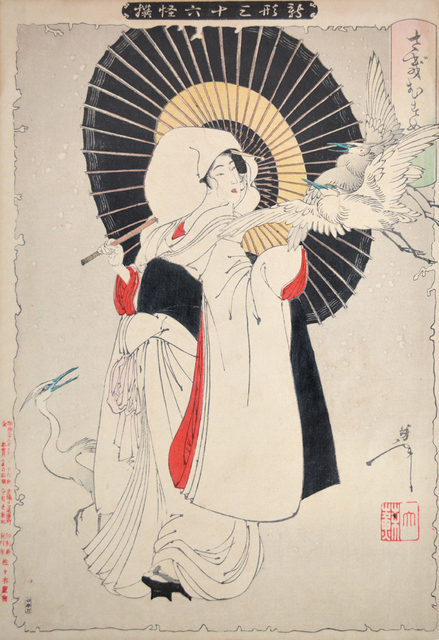
The title points to Yoshitoshi's series "Wakan hyaku monogatari" (One Hundred Ghost Tales of China and Japan), published in 1865 when the artist was in his mid-twenties. The series drew on the popular Edo pastime of hyaku monogatari kaidankai — gatherings at which participants told one hundred ghost stories by candlelight, extinguishing a flame after each tale — and presents supernatural episodes from Chinese and Japanese folklore in single-sheet oban format. Individual prints typically depict a single figure or pair against a sparse ground, with the supernatural element rendered through compositional dislocation, distorted anatomy, or carefully applied bokashi to suggest spectral atmosphere. Although Yoshitoshi planned a hundred designs, the series was discontinued after roughly twenty-six sheets, which has made surviving impressions sought after by collectors of his early work. The series sits at the beginning of Yoshitoshi's lifelong interest in the supernatural, an interest he would return to in later series such as "Shinkei sanjurokkaisen" (New Forms of Thirty-Six Ghosts, 1889–1892), produced near the end of his life.
More Prints by Tsukioka Yoshitoshi
Frequently Asked Questions
A mirror of strange tales of China and Japan was created by Tsukioka Yoshitoshi (月岡芳年).