
Soga no Gorô Tokimune held back by Yoritomo's wrestler bodyguard Gosho no Gorômaru
- Medium:
- Mokuhanga (Japanese woodblock)
- Image courtesy of
- Saru Gallery
Description
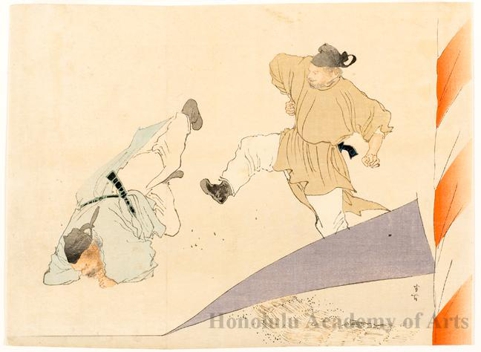
The print depicts a culminating moment from the Soga brothers' revenge tale: after Soga no Gorō Tokimune has slain his father's enemy Kudō Suketsune at Minamoto no Yoritomo's hunting camp on Mount Fuji in 1193, he attempts to press on toward the shogun himself and is bodily restrained by the sumō wrestler Gosho no Gorōmaru. Yoshitoshi gives the encounter the diagonal composition typical of his musha-e (warrior prints), with the bodyguard's mass set against the still-armoured Gorō in mid-struggle, the figures locked in a sculptural knot that registers physical force rather than martial display. The Soga vendetta — one of the three principal revenge cycles of Japanese narrative tradition alongside the Akō rōnin and Igagoe stories — was a recurring source for Yoshitoshi, who returned to its scenes throughout the 1880s as part of his project of re-energising historical and legendary subject matter for the print public of the early Meiji era.
More Prints by Tsukioka Yoshitoshi
More Sumo Prints


Frequently Asked Questions
Soga no Gorô Tokimune held back by Yoritomo's wrestler bodyguard Gosho no Gorômaru was created by Tsukioka Yoshitoshi (月岡芳年).
Soga no Gorô Tokimune held back by Yoritomo's wrestler bodyguard Gosho no Gorômaru depicts sumo.