
Onoe Baiko VII as the demon of Ibaraki in the play Ibaraki.
- Medium:
- Mokuhanga (Japanese woodblock)
- Image courtesy of
- Saru Gallery
Description
A close-up frontal portrait of a kabuki actor in demon makeup, with a pale white face, deep furrowed brow, wide glaring eyes, and a heavy dark moustache and downturned mouth painted in bold black lines. Long white wig hair streams down both sides of the face in fine wavy strands, and the figure wears a gold and ochre robe patterned with leaf motifs, with clawed fingers visible at the lower edge gripping an object; a dark patterned ground fills the upper right background. A small red seal appears in the upper right corner. This is a mokuhanga (Japanese woodblock print) by Tsuruya Kokei depicting Onoe Baiko VII as the demon of Ibaraki in the play *Ibaraki*; the year is unknown.
More Prints by Tsuruya Kokei

Kataoka Nizaemon XIII as Ishikawa Goemon in the play Sanmon Gosan no Kiri
Mokuhanga (Japanese woodblock)
The Tayu (High-ranking Courtesan)
Woodblock print on ganpi paper with mica
Ichikawa Danshiro IV as Akushichibyoe Kagekiyo
Woodblock print on ganpi paper with mica
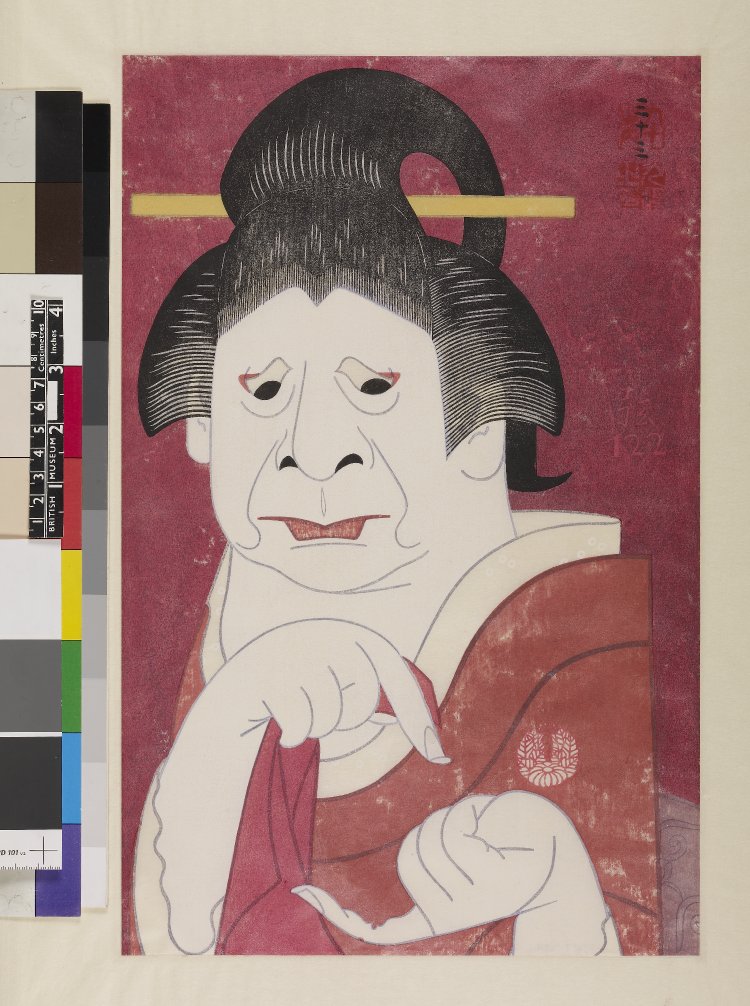
Onoe Baiko VII as Masaoka 七世尾上梅幸の乳人政岡 / Bust portraits VIII (Design 4) 第八期大首絵シリーズの4
Woodblock print
Featured in Collections
Curated cross-cuts that include this print.
Frequently Asked Questions
Onoe Baiko VII as the demon of Ibaraki in the play Ibaraki. was created by Tsuruya Kokei (弦屋光溪).