
Untitled work by Tsuruya Kokei
- Source:
- ukiyo-e.org
Description
This untitled work by Tsuruya Kokei belongs to the artist's celebrated body of contemporary yakusha-e, the kabuki actor prints that established him as one of the most distinctive woodblock printmakers of the late twentieth century. Born in 1946 and active in Tokyo since the late 1970s, Kokei revived the bust-portrait (okubi-e) format associated with Edo-period masters such as Toshusai Sharaku and Utagawa Kunimasa, applying it to the living actors of his own day. He has worked almost entirely outside the commercial publishing system, designing, carving, and printing each sheet himself in editions usually limited to roughly seventy impressions, and circulating them through a small circle of subscribers and a handful of museums. As a result, every Kokei print, including untitled or privately distributed sheets like this one, carries the marks of a single artisan's hand from drawing to finished impression. The print's subject - almost certainly a portrait of a Kabuki-za performer in a specific role - is treated with the close attention to physiognomy and stage presence that defines Kokei's mature work. Faces are rendered with restrained line, with the actor's individual features emphasized over the stylized masks of much earlier yakusha-e. Backgrounds are typically reduced to a flat ground tone or mica wash, throwing the figure forward and stripping away theatrical context so that expression, costume pattern, and posture carry the picture. The understated palette, often built on muted greys, ochres, and selectively saturated reds, reflects Kokei's interest in subtle tonal contrast rather than the bright synthetic colors common in twentieth-century reproductions of ukiyo-e themes. The Minneapolis Institute of Art holds the impression documented here through the ukiyo-e.org reference image, situating the work within a museum collection that has steadily acquired Kokei's kabuki actor prints as a continuation of the historic ukiyo-e tradition. For collectors and researchers, this sheet stands as a representative example of how Tsuruya Kokei has carried the formal vocabulary of Edo portraiture into the contemporary theater world.
More Prints by Tsuruya Kokei

Kataoka Nizaemon XIII as Ishikawa Goemon in the play Sanmon Gosan no Kiri
Mokuhanga (Japanese woodblock)
The Tayu (High-ranking Courtesan)
Woodblock print on ganpi paper with mica
Ichikawa Danshiro IV as Akushichibyoe Kagekiyo
Woodblock print on ganpi paper with mica
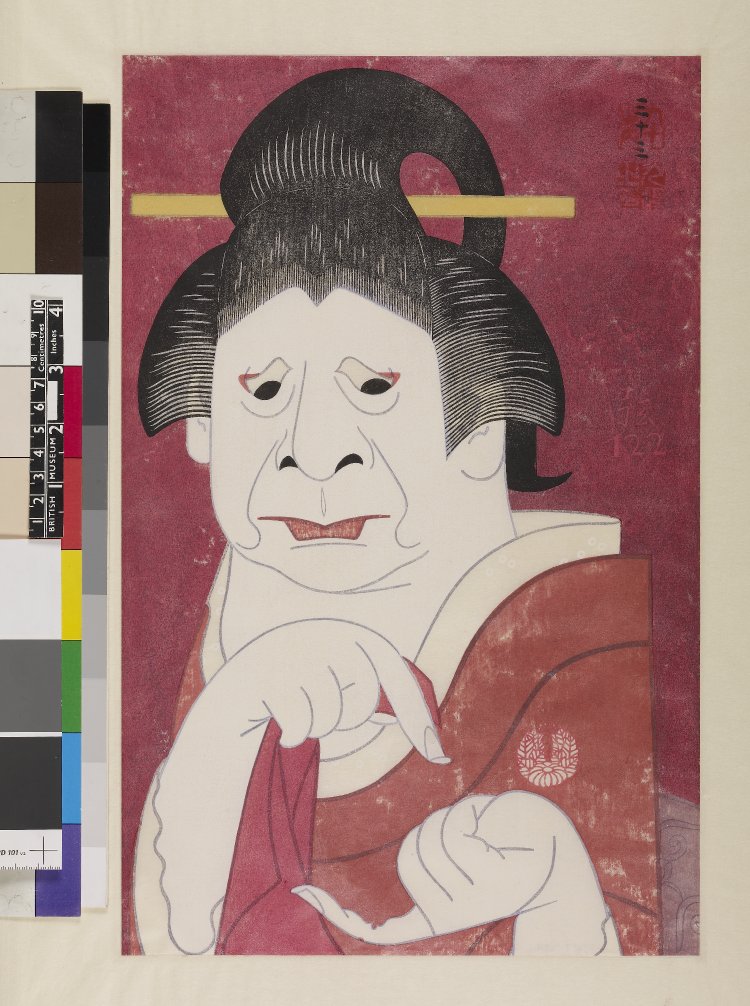
Onoe Baiko VII as Masaoka 七世尾上梅幸の乳人政岡 / Bust portraits VIII (Design 4) 第八期大首絵シリーズの4
Woodblock print
Featured in Collections
Curated cross-cuts that include this print.
Frequently Asked Questions
(untitled) was created by Tsuruya Kokei (弦屋光溪).