
Bijin in Kimono
by Uemura Shoen
- Source:
- ukiyo-e.org
Description
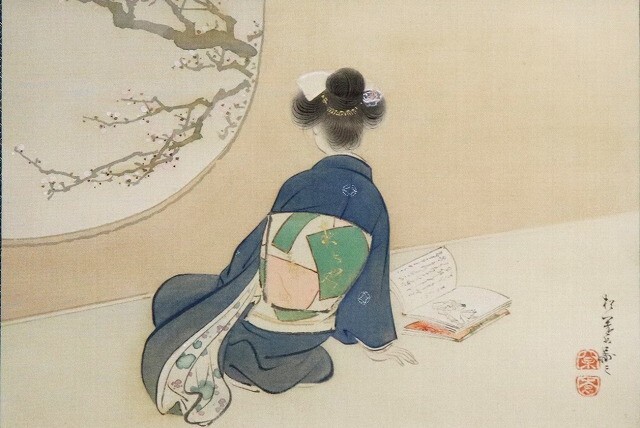
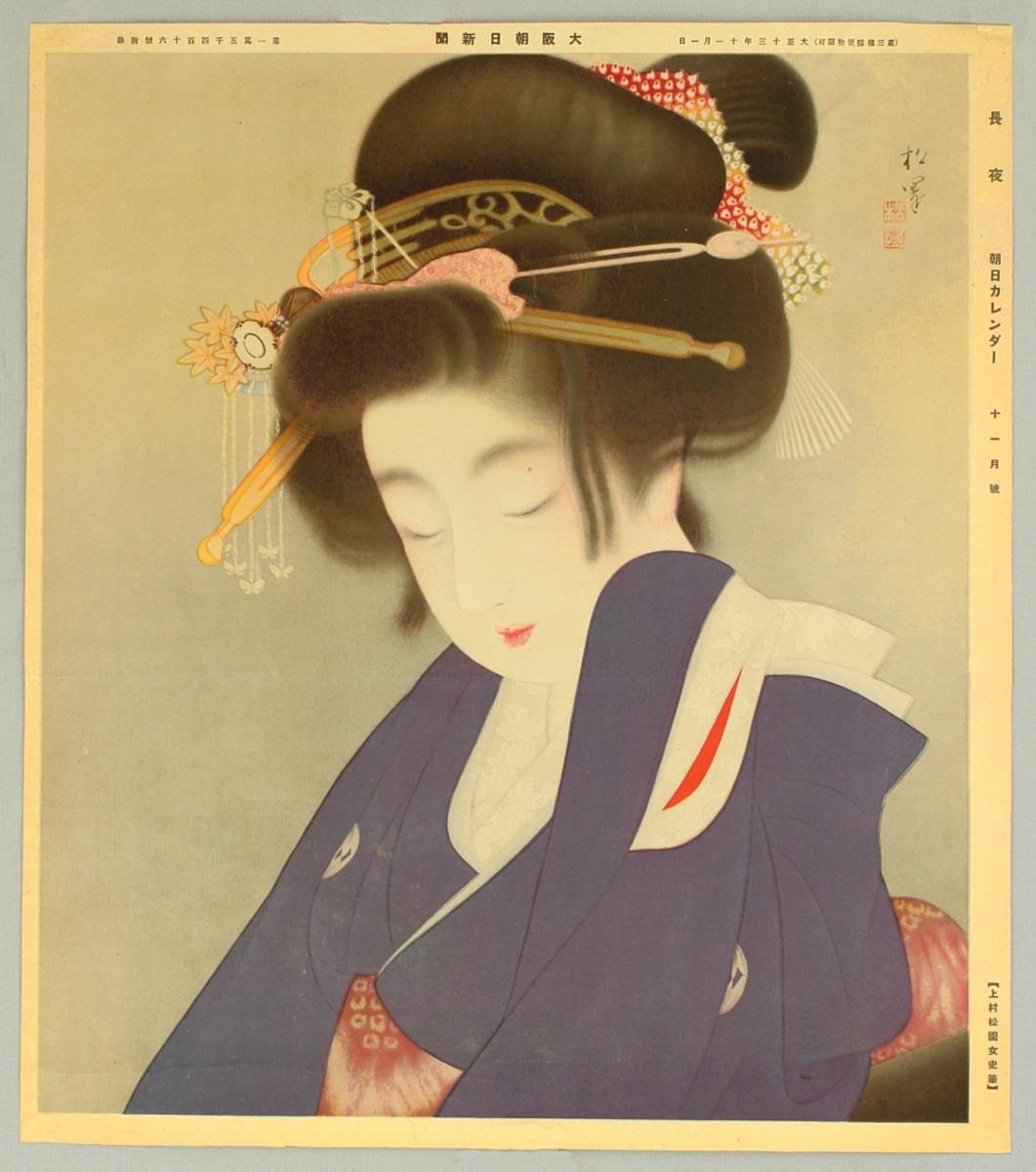
Bijin in Kimono is preserved on ukiyo-e.org under an attribution to Uemura Shoen via the Japanese Art Open Database aggregator, and presents the artist's signature subject in its purest form: a single woman, fully dressed in kimono, considered with sustained attention. Uemura Shoen (1875-1949) made the kimono-clad bijin the centre of her practice, returning to it across more than five decades of Kyoto nihonga painting and through the entire arc of Taisho-Showa bijin-ga. In her hands the garment is never a costume study alone, but a structure that disciplines the figure: the obi anchors the torso, the long sleeves describe the gesture of the arms, the hem registers movement and stillness. Trained in the Shijo lineage and steeped in the Kyoto culture of textile design, dyeing, and seasonal change, Shoen used kimono patterns to encode information about age, marital status, season, and mood, choosing motifs such as bush clover, plum blossom, or paulownia with calculated precision. She wrote that she wanted her women to embody a quiet, jewel-like purity, and the formal restraint of kimono painting was the means by which she sought it: heads tilt, eyes lower, hands fold, and the viewer is invited to read interior life through these small adjustments. Within the wider Taisho-Showa bijin-ga environment, dominated commercially by Tokyo-based shin hanga print publishers, Shoen represented the fine-art alternative grounded in Kyoto nihonga. Even where, as here, specific year and provenance are not fully recorded, Bijin in Kimono can be read as a distillation of her programme. Source: ukiyo-e.org via the Japanese Art Open Database; comparable confirmed works are held at the Adachi Museum of Art and Yamatane Museum.
More Prints by Uemura Shoen
Frequently Asked Questions
Bijin in Kimono was created by Uemura Shoen (上村松園).