
Three-day spring moon
- Medium:
- Mokuhanga (Japanese woodblock)
- Image courtesy of
- Saru Gallery
Description
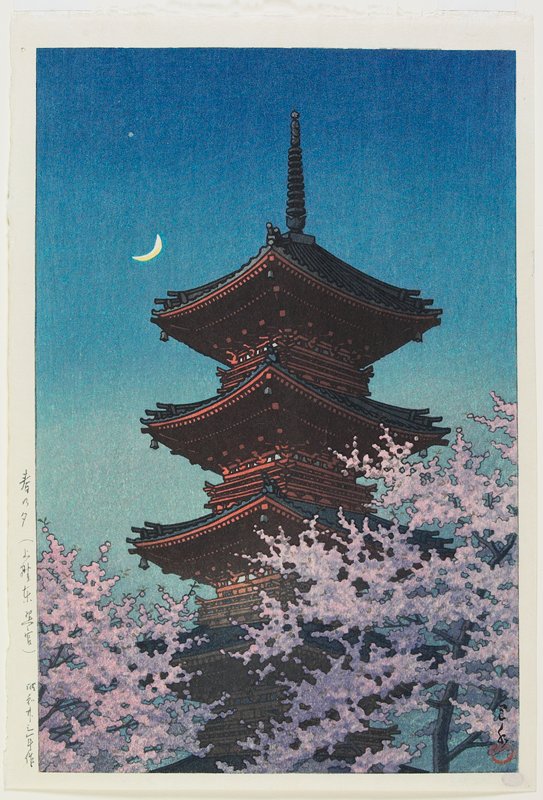
A depiction of the mikazuki, the thin crescent visible roughly three days after the new moon, set in a spring context that traditionally implies budding branches, mist, or the muted palette of early-season landscape. In Japanese visual convention the three-day moon carries a long iconographic history extending back through Edo-period haiku illustration and Buddhist devotional imagery, where the slender crescent functions as a calendar marker as much as a celestial subject. Hiratsuka's treatment in woodcut would isolate the crescent as a precisely carved white reserve against a tonally worked sky, with spring foliage rendered in the cut-line vocabulary he developed for branchwork — short angular strokes that read as both bark and twig. The print fits within his sustained engagement with seasonal and lunar subjects, a thematic continuity he maintained alongside his architectural work and one that connects his sosaku-hanga practice to older kacho-e and meisho-e categories without imitating their decorative conventions.
More Prints by Hiratsuka Un'ichi


More Spring Prints

Featured in Collections
Curated cross-cuts that include this print.
Frequently Asked Questions
Three-day spring moon was created by Hiratsuka Un'ichi (平塚運一).
Three-day spring moon depicts spring and moonlight.