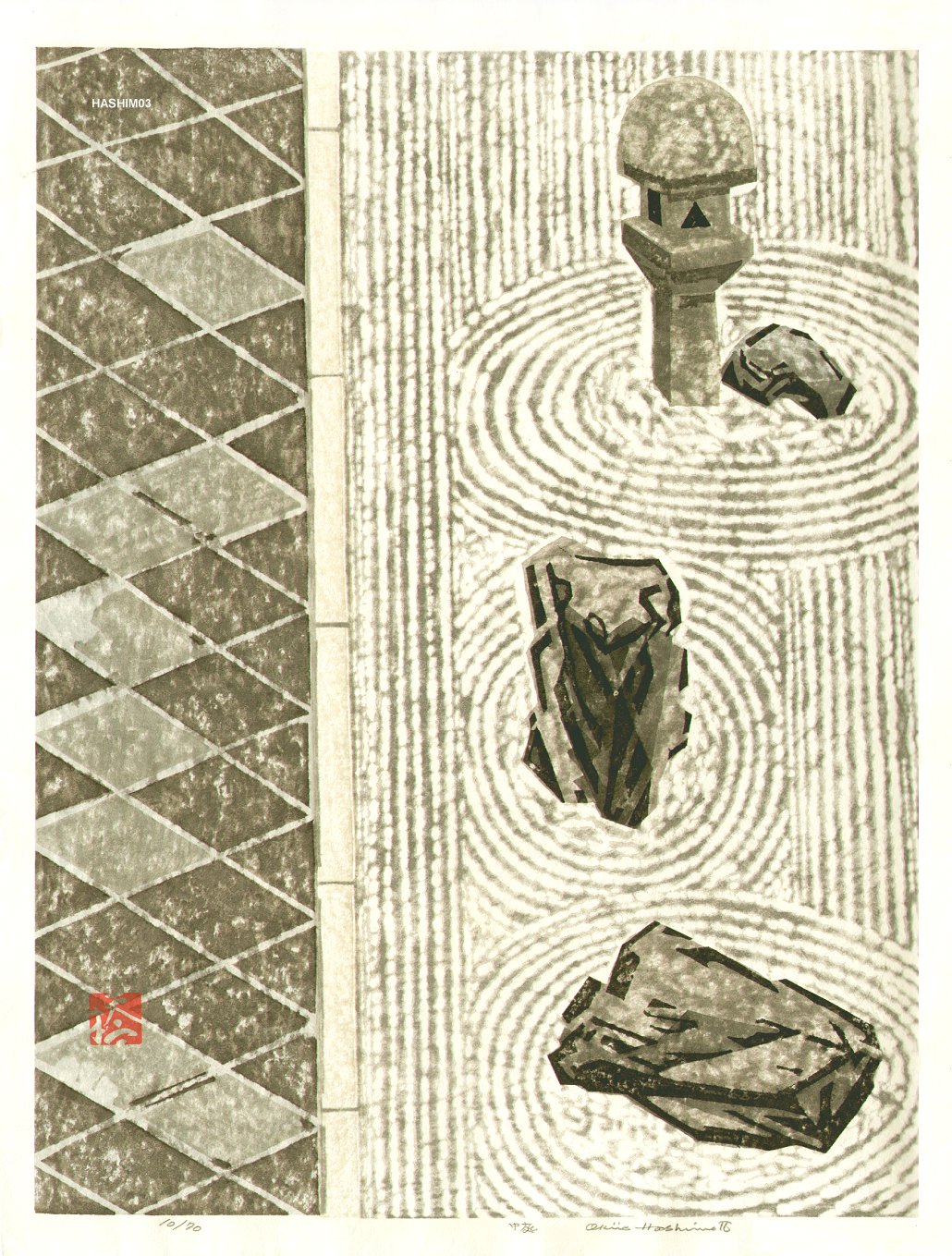
Ueno Park
- Medium:
- Mokuhanga (Japanese woodblock)
- Image courtesy of
- Saru Gallery
Description
Ueno Park, opened in 1873 as one of Tokyo's first public parks, occupies the grounds of the former Kan'ei-ji temple complex on the bluff above Shinobazu Pond. Hiratsuka returned to the park's landmarks—its temple buildings, pagoda, paths, and pond—across multiple prints in his long career, treating the site as a Tokyo meisho rendered in his signature black-and-white woodcut idiom. The composition likely emphasizes architectural elements of the park, perhaps a shrine gate, the Kiyomizu Kannon-do, the Tosho-gu shrine, or the silhouette of trees against open sky, with carved planes of solid black playing against the white of the unprinted washi. Where Hiroshige's One Hundred Famous Views of Edo treated similar Ueno subjects with the layered color and bokashi gradation of nishiki-e, Hiratsuka pares the imagery to its essential graphic elements, in keeping with the sosaku-hanga commitment to the artist's individual hand at every production stage. The park's Edo-period religious architecture and its Meiji-era reinvention as public civic space made it a recurring subject for printmakers across multiple generations.


![[Garden of] Taj Mahal, No. 1 (Taji Maharu no niwa, dai ichi) by Hiroshi Yoshida](https://www.artic.edu/iiif/2/230993a7-d4f0-c979-c267-127d48e1ef1c/full/843,/0/default.jpg)