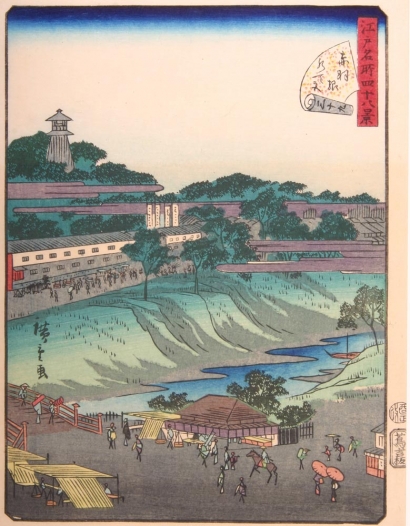
Akabane
- Medium:
- Woodblock print
- Source:
- Art Gallery of Greater Victoria
- Image courtesy of
- Art Gallery of Greater Victoria
Description
Akabane, located at the northern edge of Edo where the Arakawa River provided a major ferry crossing, appears in several of Hiroshige's topographical series depicting the city's outlying districts. This print likely shows the riverside embankment or the ferry landing, with low-lying terrain characteristic of the Kanto plain stretching toward the horizon. Hiroshige's treatment of such transitional zones—neither fully urban nor rural—typically employs expansive skies rendered with horizontal bokashi gradations and diminutive human figures that emphasize the scale of the landscape over individual activity. Reed beds or low willows along the water's edge would anchor the foreground, while boats or a distant tree line mark the far bank. The Akabane crossing was a practical node on routes connecting Edo to the north, and Hiroshige's framing would balance the prosaic function of the location with an atmospheric, seasonal mood. The print exemplifies his ability to find compositional interest in the unremarkable edges of the city.
More Prints by Utagawa Hiroshige


More Urban Scenes Prints
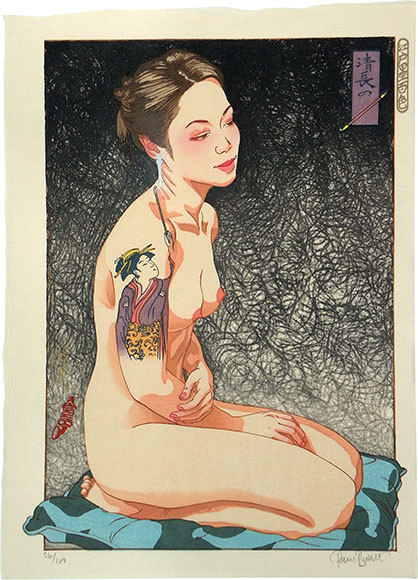
A Hundred Shades of Ink of Edo: Kiyonaga's Pipe (Edo zumi hyaku shoku: Kiyonaga no kiseru)
Woodblock print

View of Kabuki Theater from Matsuya (Ginza Matsuya yori Kabukiza), no. 3 from the series "Pictures of Ginza, First Series (Gashu Ginza dai isshu)"
1928
Color lithograph

Distant View of Mitsukoshi Movie Theater in Shinjuku from the Sixth Floor of Hoteiya (Hoteiya rokkai kara Shinjuku Mitsukoshi Musashi no kan enbo zu), no. 1 from the series "Scenery of Shinjuku (Gashu Shinjuku fukei)"
1930
Color lithograph
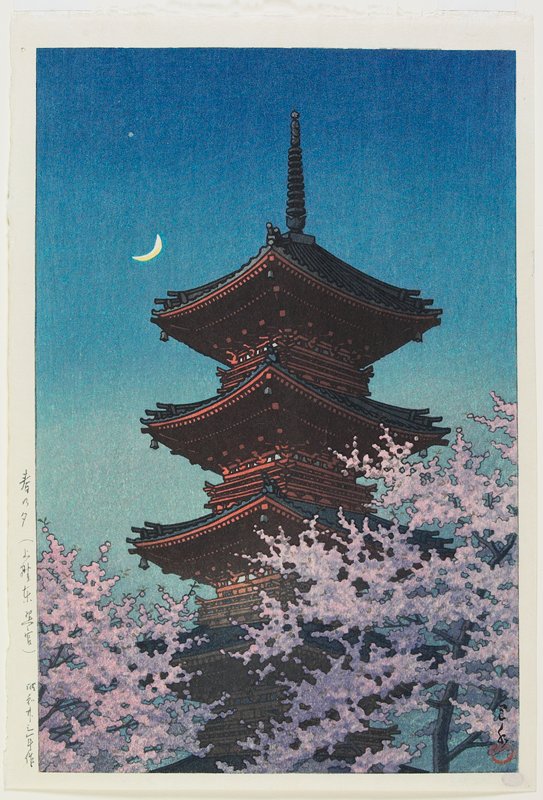
Spring Dusk at the Tōshō Shrine in Ueno
1948
Woodblock print, ink and color on paper
Frequently Asked Questions
Akabane was created by Utagawa Hiroshige (歌川広重).
Akabane depicts urban scenes.