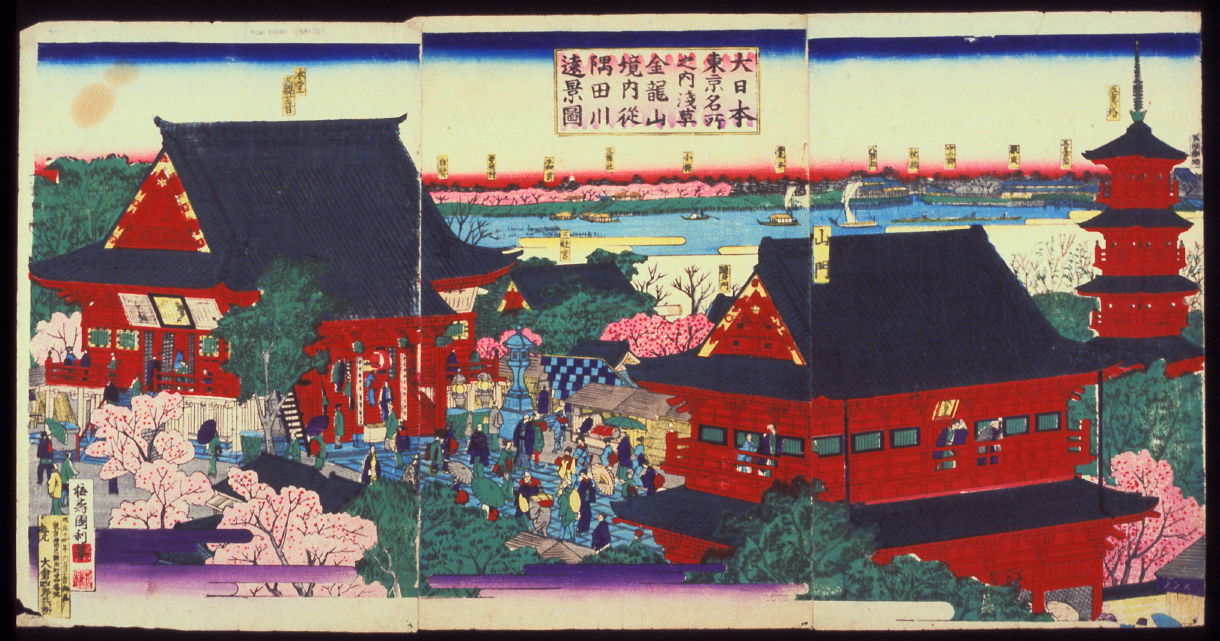
The Sumida River from the Precincts of Kinryūzan Temple in Asakusa, from the series Famous Places in Tokyo
- Date:
- 1881
- Medium:
- Color woodcut triptych
Description
This 1881 colour woodcut triptych by Utagawa Kunitoshi, held by the Fine Arts Museums of San Francisco at the Legion of Honor (accession 1963.30.5711abc), depicts the Sumida River as seen from the precincts of Kinryūzan, the Asakusa Sensō-ji temple complex that is the oldest and most celebrated Buddhist site in Tokyo. The print belongs to the artist's series Famous Places in Tokyo (Tōkyō meisho), a documentary undertaking that occupied much of his mature career and produced dozens of single-sheet and multi-panel views of the great religious, governmental, and commercial sites of the city. The composition, in the standard triptych dimensions of around 35 by 71 cm, exploits the wide horizontal format to encompass the temple buildings on one side and the broad expanse of the Sumida River on the other, with crowds of pilgrims and townspeople moving between the two and the masts of river boats traversing the middle distance. The print was published by Ōkura Shirobei, one of the major Meiji-era publishers of Tokyo meisho-e, and is a representative example of the Asakusa scenes that recur throughout Kunitoshi's oeuvre. Asakusa was the spiritual heart of Edo-period Tokyo and remained so under Meiji, with the Sensō-ji temple and its annual festivals attracting massive crowds; print series like this one served both as commemorative records for pilgrims and as decorative reminders for distant viewers. The print is preserved in the Achenbach Foundation for Graphic Arts at the Legion of Honor.
More Prints by Utagawa Kunitoshi

Frequently Asked Questions
The Sumida River from the Precincts of Kinryūzan Temple in Asakusa, from the series Famous Places in Tokyo was created by Utagawa Kunitoshi (歌川国利) in 1881.