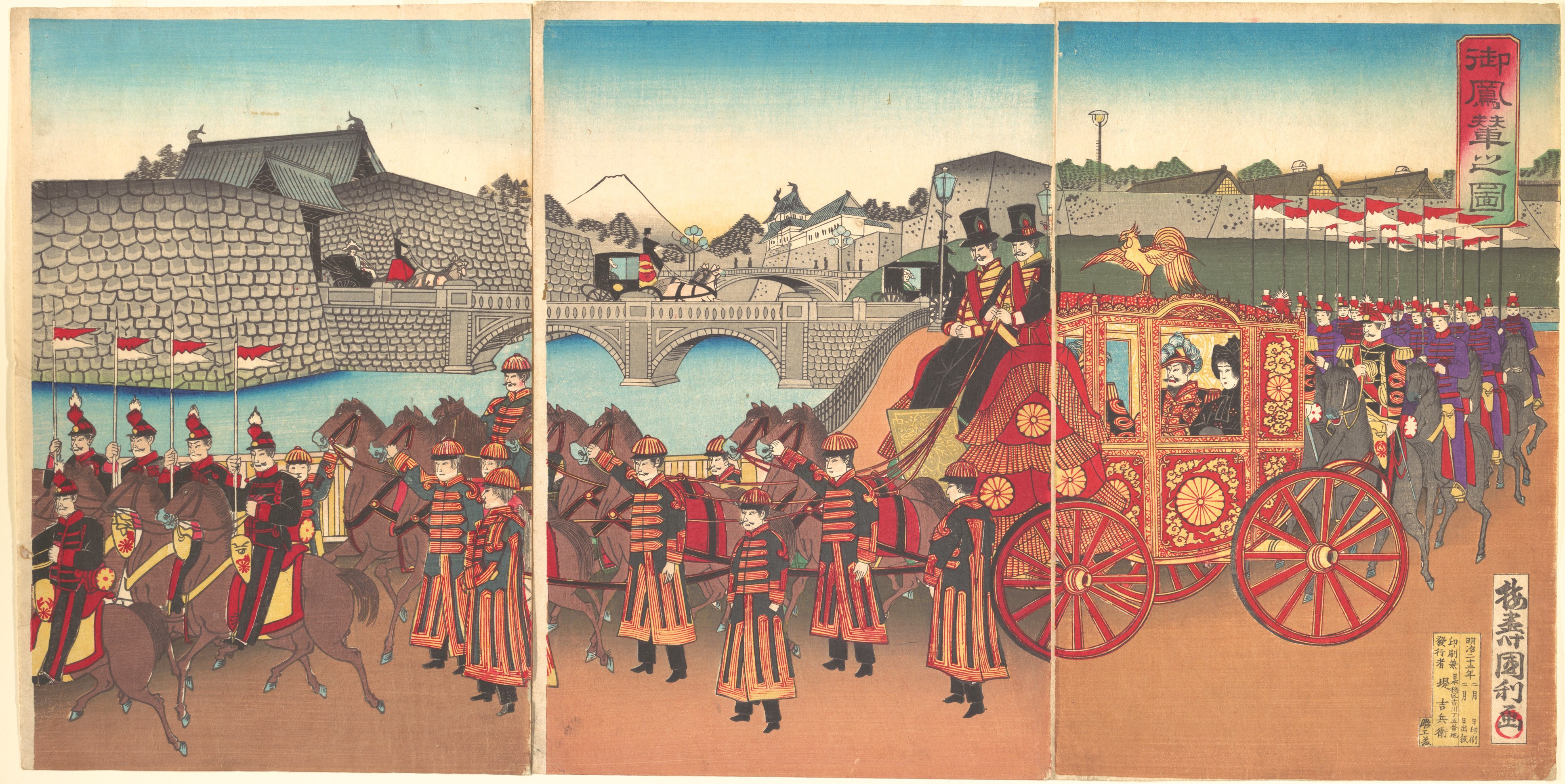
View of the Imperial Carriage
- Date:
- 1889 (Meiji 22)
- Medium:
- Woodblock print (nishiki-e), ink and color on paper
Description
This Meiji-era woodblock print, held by the Metropolitan Museum of Art (accession DP146905), depicts the imperial carriage during one of the great ceremonial processions of 1889. The print belongs to Utagawa Kunitoshi's substantial body of work documenting the public ceremonies of the new constitutional state — coronations, military reviews, foreign embassies, and the elaborate court rituals through which the young Emperor Meiji was presented to his subjects as the sovereign of a modern monarchy. The compositional template is characteristic of Kunitoshi's mature ceremonial style: a horse-drawn imperial carriage at the centre of the sheet, flanked by Western-uniformed cavalry and ceremonial guards, with onlookers and the architecture of the new Tokyo in the background. Prints of this kind were issued in large editions by the publishing houses of Nihonbashi and Asakusa to satisfy urban demand for visual records of the period's great public events, and they constitute one of the principal visual sources for the choreographed pageantry of the Meiji state. Kunitoshi's handling of the carriage scene combines the linear precision of late-Utagawa school yakusha-e with the new Meiji palette of brighter reds, blues, and purples derived from imported aniline dyes, producing the high-keyed colour that marks Meiji prints off from their late-Edo predecessors. The print is preserved in the Metropolitan Museum of Art's holdings of nineteenth-century Japanese prints and is a representative example of the artist's contribution to the documentary visual culture of constitutional Japan.
More Prints by Utagawa Kunitoshi

Frequently Asked Questions
View of the Imperial Carriage was created by Utagawa Kunitoshi (歌川国利) in 1889 (Meiji 22).