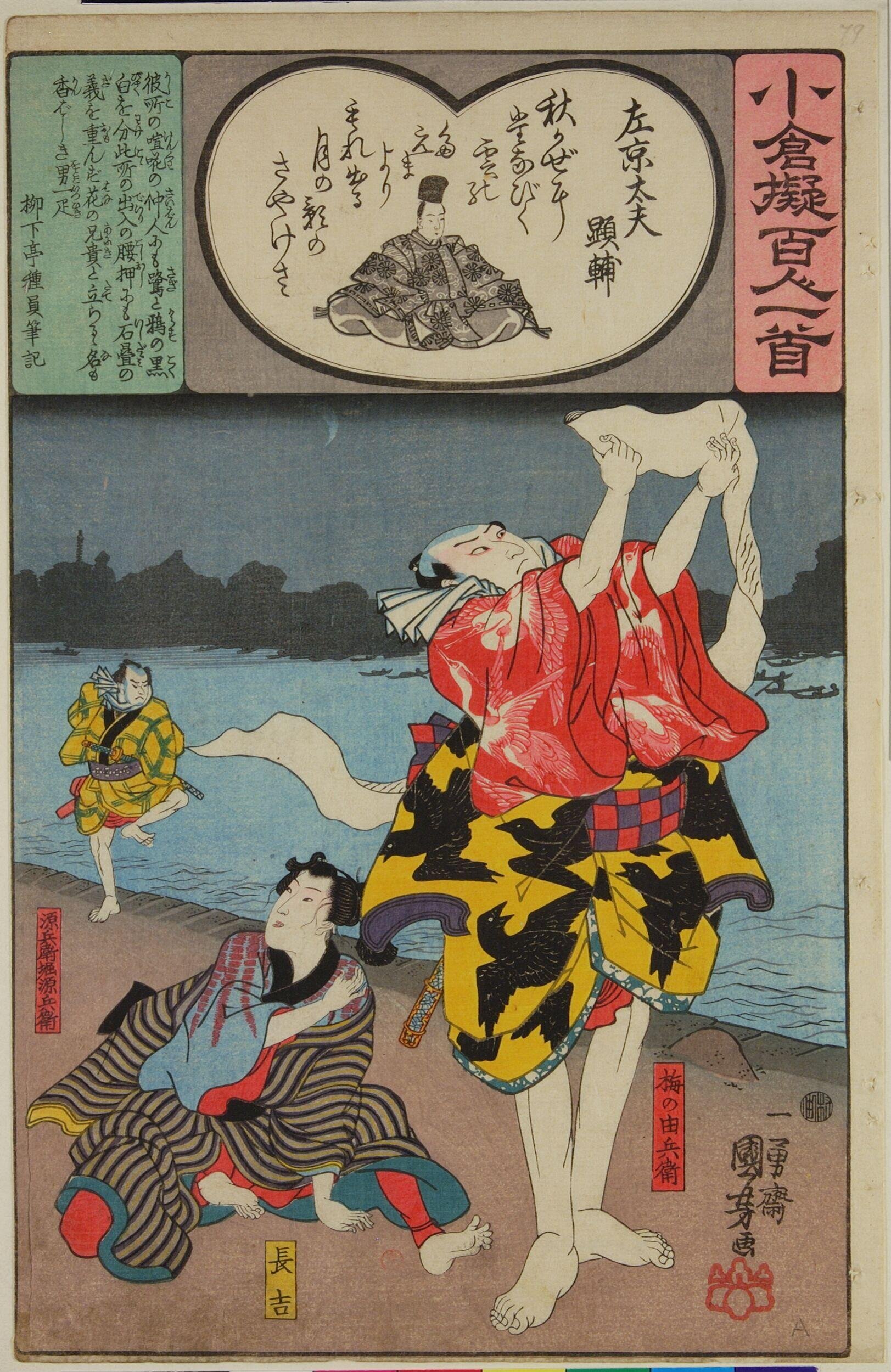
Poem by Fujiwara no Akisuke
- Date:
- ca. 1845-48
- Medium:
- Source:
- Victoria and Albert Museum
Description
Poem by Fujiwara no Akisuke is a 1845 sheet by Utagawa Kuniyoshi from the celebrated series Ogura nazora-e Hyaku-nin isshu, the "Ogura Imitations of One Hundred Poems by One Hundred Poets," preserved by the Victoria and Albert Museum. In this collaborative project Kuniyoshi worked alongside Hiroshige and Kunisada to illustrate the Hyakunin Isshu anthology, with each designer assigned a portion of the one hundred poems and asked to pair them with imaginative pictorial "imitations" drawn from history, legend, and the kabuki stage. Kuniyoshi's response to Fujiwara no Akisuke's classical waka exemplifies his ability to channel the breadth of his career — warrior prints, ghostly subjects, theatrical portraits, beauty pictures — into a single focused design. A cartouche containing the poem and its author crowns the composition, while the lower portion presents Kuniyoshi's chosen figural subject, rendered with the firm outline drawing and balanced colour blocks typical of high-quality 1840s Edo woodblock printing. Costume, hair, and accessories carry historical and dramatic resonance for a contemporary Edo viewer attuned to the references being made. The Victoria and Albert Museum's broad holdings of this series allow scholars to study Kuniyoshi's design choices alongside those of his collaborators and to appreciate how classical poetry was repeatedly reinterpreted through the popular visual idiom of Edo ukiyo-e. As one of his contributions to this project, the print attests to his role in shaping mid-nineteenth-century literary and pictorial culture in Edo.
More Prints by Utagawa Kuniyoshi
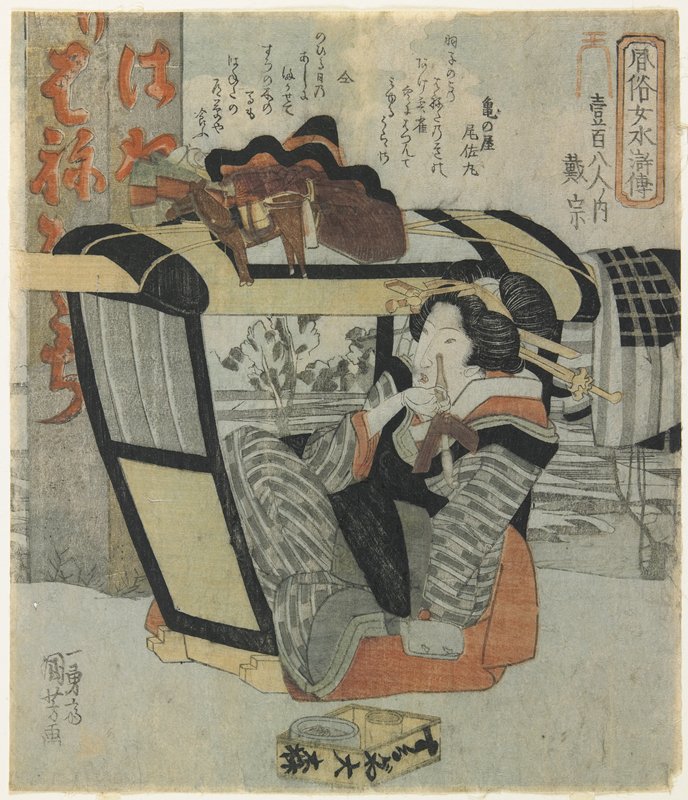
Woman as the Hero Taisō in Palanquin Holding a Pipe
c. 1830
Woodblock print (surimono), ink and color on paper

Yan Qing (Roshi Ensei), from the series "One Hundred and Eight Heroes of the Popular Water Margin (Tsuzoku Suikoden goketsu hyakuhachinin no hitori)"

Poem by Abe no Nakamaro, from an untitled series of One Hundred Poems by One Hundred Poets

Hu Sanniang (Ko Sanjo Ichijosei), from the series "One Hundred and Eight Heroes of the Popular Water Margin (Tsuzoku Suikoden goketsu hyakuhachinin no hitori)"
More Mount Fuji Prints
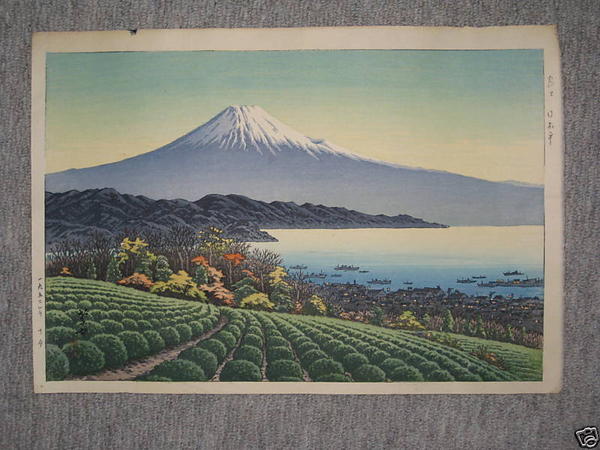
Fuji from tea farm
Woodblock print

Akasaka, Fujikawa, Okazaki, Chiryu, and Narumi, from the series "Famous Places on the Fifty-three Stations of the Tokaido, Five Stations (Tokaido gojusan eki goshuku meisho)"
c. 1830/35
Color woodblock print; oban
![Mount Fuji on a Moonlit Night, Kawai Bridge (Tsukiyo no Fuji [Kawaibashi]), from the series "Selection of Views of the Tokaido (Tokaido fukei senshu)" by Kawase Hasui](https://www.artic.edu/iiif/2/d0960668-1e73-339a-b182-fb995a54bff0/full/843,/0/default.jpg)
Mount Fuji on a Moonlit Night, Kawai Bridge (Tsukiyo no Fuji [Kawaibashi]), from the series "Selection of Views of the Tokaido (Tokaido fukei senshu)"
1947
Color woodblock print; oban

Mt. Fuji in Rain (Ame no Fuji)
n.d.
Color woodblock print
Featured in Collections
Curated cross-cuts that include this print.
Frequently Asked Questions
Poem by Fujiwara no Akisuke was created by Utagawa Kuniyoshi (歌川国芳) in ca. 1845-48.
Poem by Fujiwara no Akisuke depicts mount fuji.