![Praying for Rain at Ryozengasaki in Kamakura, 1271 (Bun'ei hachi Kamakura Ryozengasaki ame inoru), from the series "Concise Illustrated Biography of the Great Priest [Nichiren] (Koso go ichidai ryakuzu)" by Utagawa Kuniyoshi — Japanese Color woodblock print; oban, c. 1830/35](https://www.artic.edu/iiif/2/4a497108-12ad-0923-2dba-6e9acef02ee5/full/843,/0/default.jpg)
Praying for Rain at Ryozengasaki in Kamakura, 1271 (Bun'ei hachi Kamakura Ryozengasaki ame inoru), from the series "Concise Illustrated Biography of the Great Priest [Nichiren] (Koso go ichidai ryakuzu)"
- Date:
- c. 1830/35
- Medium:
- Color woodblock print; oban
- Source:
- Art Institute of Chicago
Description
Praying for Rain at Ryozengasaki in Kamakura, 1271 dramatises one of the most famous miracles attributed to the priest Nichiren and forms part of Utagawa Kuniyoshi's Concise Illustrated Biography of the Great Priest, a major biographical cycle published around 1825. The print, preserved in the Art Institute of Chicago, depicts Nichiren's confrontation with a rival cleric at Ryozengasaki, where he reportedly succeeded, after his opponent's failure, in summoning rain through chanted invocation of the Lotus Sutra and the daimoku. Kuniyoshi stages the episode as a tense, weather-charged tableau: the priest stands resolute amid a turbulent coastal landscape while the sky gathers and breaks above him, sea spray and incoming clouds rendered with sharp graphic line and nuanced bokashi gradation. The series as a whole reflects the importance of Nichiren-shu devotion in Edo and the appetite for narrative print sets that combined religious instruction with the spectacular drama of musha-e. Although the project is not strictly a warrior series, it borrows the explosive natural settings, dynamic compositional sweep, and emotional intensity that mark Kuniyoshi's contributions to Edo ukiyo-e warrior prints. The Ryozengasaki episode also resonates with the Hakata Bay typhoon stories that helped frame Nichiren's mid-thirteenth-century career, when Mongol invasion fears and political tensions placed the Kamakura shogunate under enormous pressure. In Kuniyoshi's interpretation, the priest's body becomes a still axis around which the storm churns, an iconographic move that he would extend in subsequent religious and historical compositions across his long career.
More Prints by Utagawa Kuniyoshi
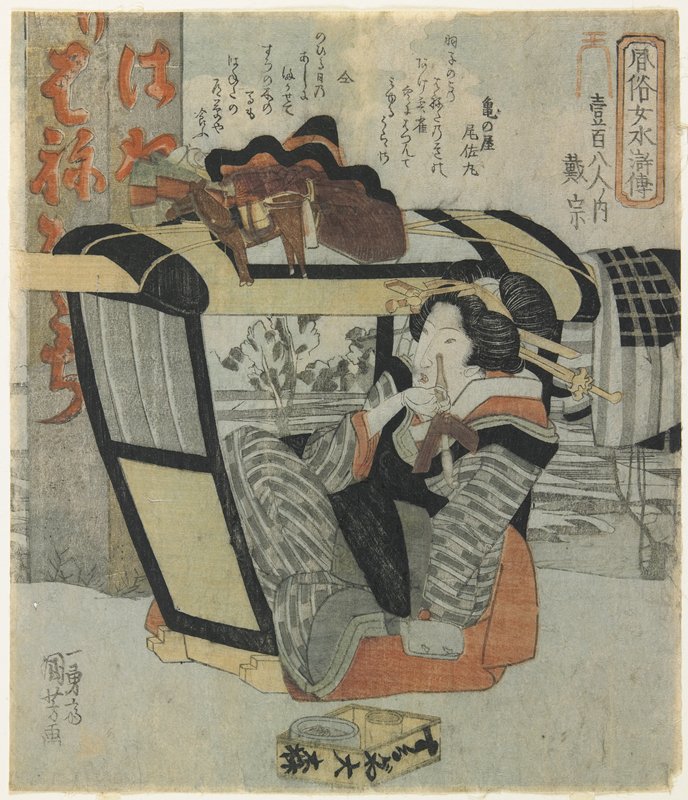
Woman as the Hero Taisō in Palanquin Holding a Pipe
c. 1830
Woodblock print (surimono), ink and color on paper

Yan Qing (Roshi Ensei), from the series "One Hundred and Eight Heroes of the Popular Water Margin (Tsuzoku Suikoden goketsu hyakuhachinin no hitori)"

Poem by Abe no Nakamaro, from an untitled series of One Hundred Poems by One Hundred Poets

Hu Sanniang (Ko Sanjo Ichijosei), from the series "One Hundred and Eight Heroes of the Popular Water Margin (Tsuzoku Suikoden goketsu hyakuhachinin no hitori)"
More Figures Prints
Frequently Asked Questions
Praying for Rain at Ryozengasaki in Kamakura, 1271 (Bun'ei hachi Kamakura Ryozengasaki ame inoru), from the series "Concise Illustrated Biography of the Great Priest [Nichiren] (Koso go ichidai ryakuzu)" was created by Utagawa Kuniyoshi (歌川国芳) in c. 1830/35.
Yes — Praying for Rain at Ryozengasaki in Kamakura, 1271 (Bun'ei hachi Kamakura Ryozengasaki ame inoru), from the series "Concise Illustrated Biography of the Great Priest [Nichiren] (Koso go ichidai ryakuzu)" is part of the Concise Illustrated Biography of the Great Priest [Nichiren] (Koso go ichidai ryakuzu) series by Utagawa Kuniyoshi.
Praying for Rain at Ryozengasaki in Kamakura, 1271 (Bun'ei hachi Kamakura Ryozengasaki ame inoru), from the series "Concise Illustrated Biography of the Great Priest [Nichiren] (Koso go ichidai ryakuzu)" depicts figures and rain, set at Kamakura.