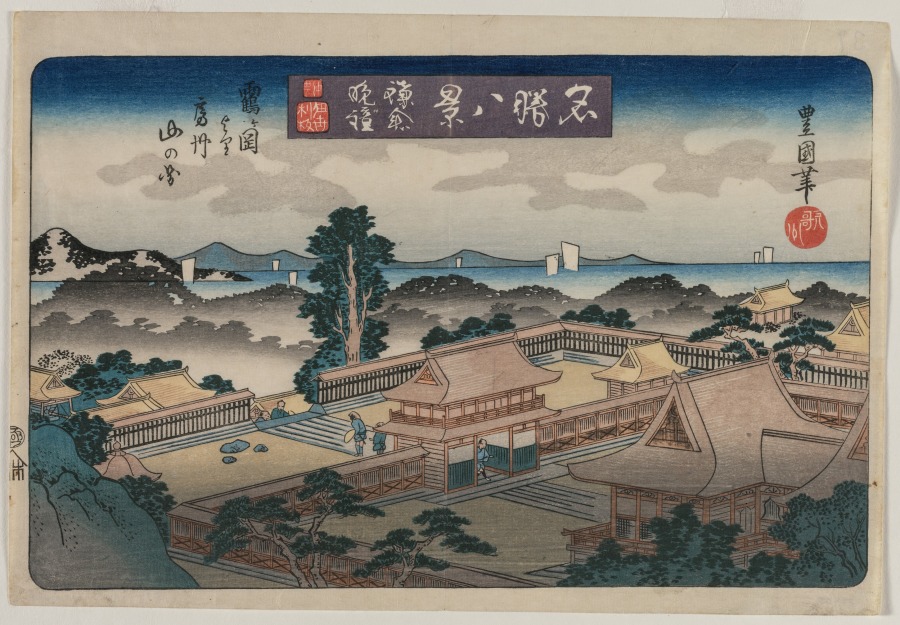
Eight Views of Famous Places: Evening Bell in Kamakura: The Mountains in Awa Province from the Hachiman Shrine in Tsurugaoka
- Date:
- early 1830s
- Medium:
- color woodblock print
- Source:
- Cleveland Museum of Art
Description
Eight Views of Famous Places: Evening Bell in Kamakura: The Mountains in Awa Province from the Hachiman Shrine in Tsurugaoka, dated 1830 and held by the Cleveland Museum of Art (accession 1985.357), belongs to Utagawa Toyokuni's late application of the classical eight-views framework to historic Japanese sites. Kamakura, the former military capital of the Minamoto shogunate, was a destination for pilgrimage and historical tourism in Edo Japan, and the Tsurugaoka Hachiman Shrine on its central hill commanded the city's principal sightline. Toyokuni's composition pairs the canonical motif of the evening bell — borrowed from the Chinese Eight Views of the Xiao and Xiang — with the Hachiman precinct, looking from the shrine across the bay toward the mountains of Awa province. As founder of the Utagawa school's leadership of Edo ukiyo-e, he applied his command of figure and ground to a landscape subject in a moment when Hokusai's Thirty-six Views of Mount Fuji and Hiroshige's later Tōkaidō series were reshaping the meisho-e genre. His treatment combines staffage figures (pilgrims, attendants, bell-ringers) with atmospheric distance. The Cleveland impression preserves the cool palette and careful keyblock printing of the late-Bunsei to early-Tenpō print market, and demonstrates how the leading Edo print designer engaged with the rising taste for landscape that would dominate the decade.
More Prints by Utagawa Toyokuni I

Segawa Kikunojō III as the Shop Boy Chōkichi
1796
Woodblock print (nishiki-e), ink and color on paper
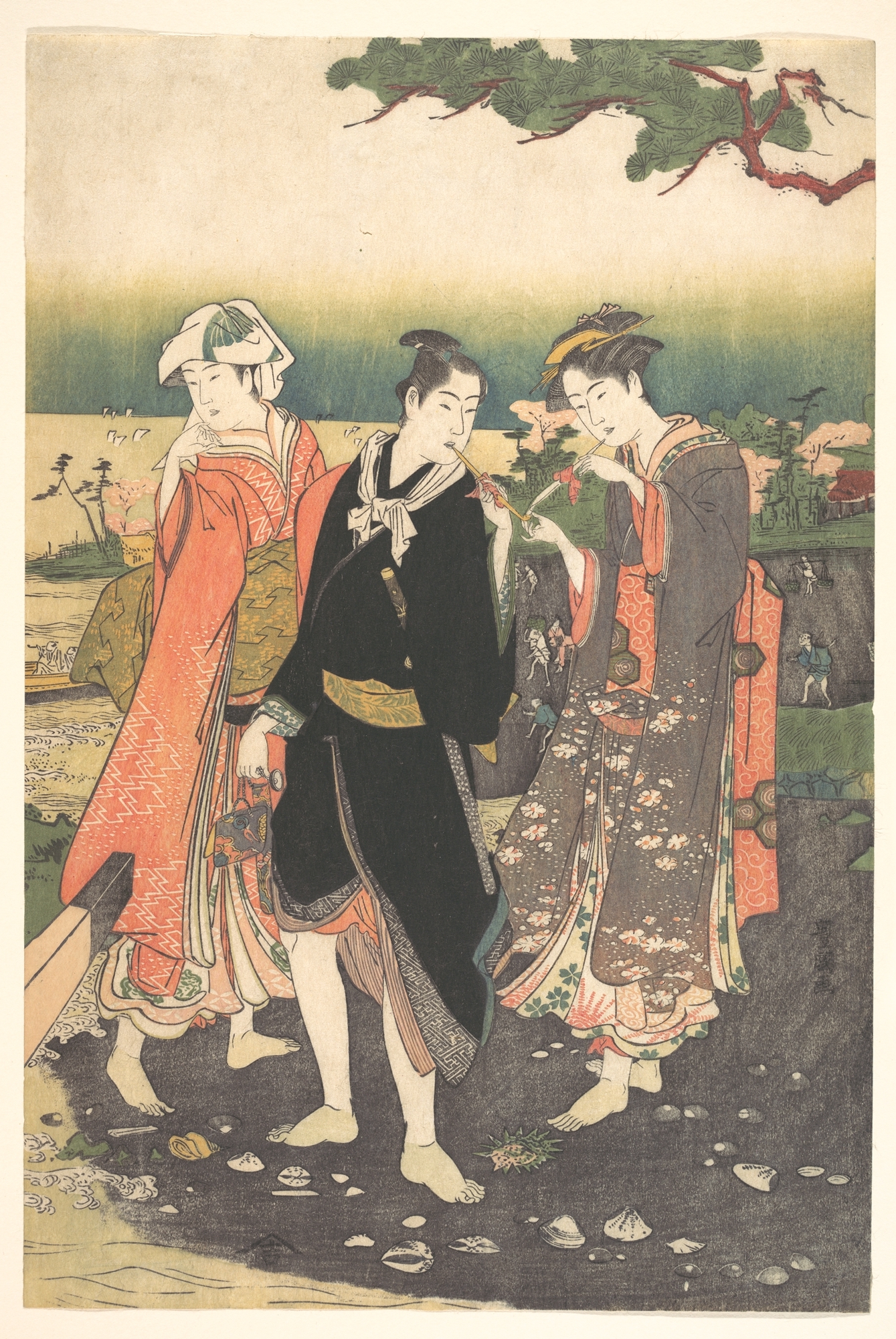
On Shinagawa Beach at Ebb-Tide
1769–1825
Woodblock print; ink and color on paper
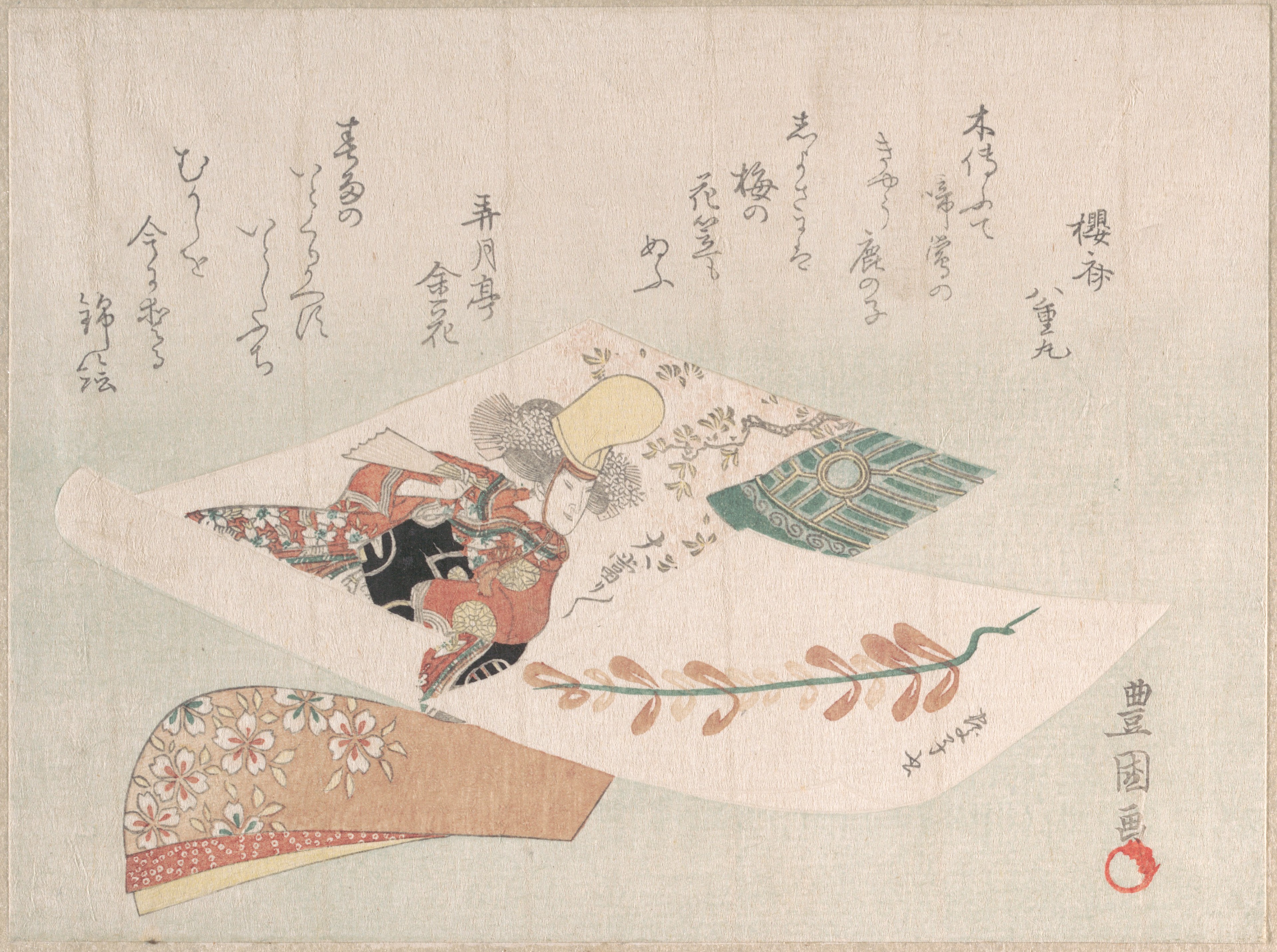
Representation of the Dance-Play "Dōjōji"
Woodblock print (surimono); ink and color on paper

The actors Sawamura Sojuro II as Satsuma Gengobei and Arashi Ryuzo II as Mawashi-otoko Yasuke in the play "Edo Sunago Kichirei Soga," performed at the Miyako Theater on the first month, 1795
c. 1795
Color woodblock print; oban
Frequently Asked Questions
Eight Views of Famous Places: Evening Bell in Kamakura: The Mountains in Awa Province from the Hachiman Shrine in Tsurugaoka was created by Utagawa Toyokuni I (歌川豊国) in early 1830s.