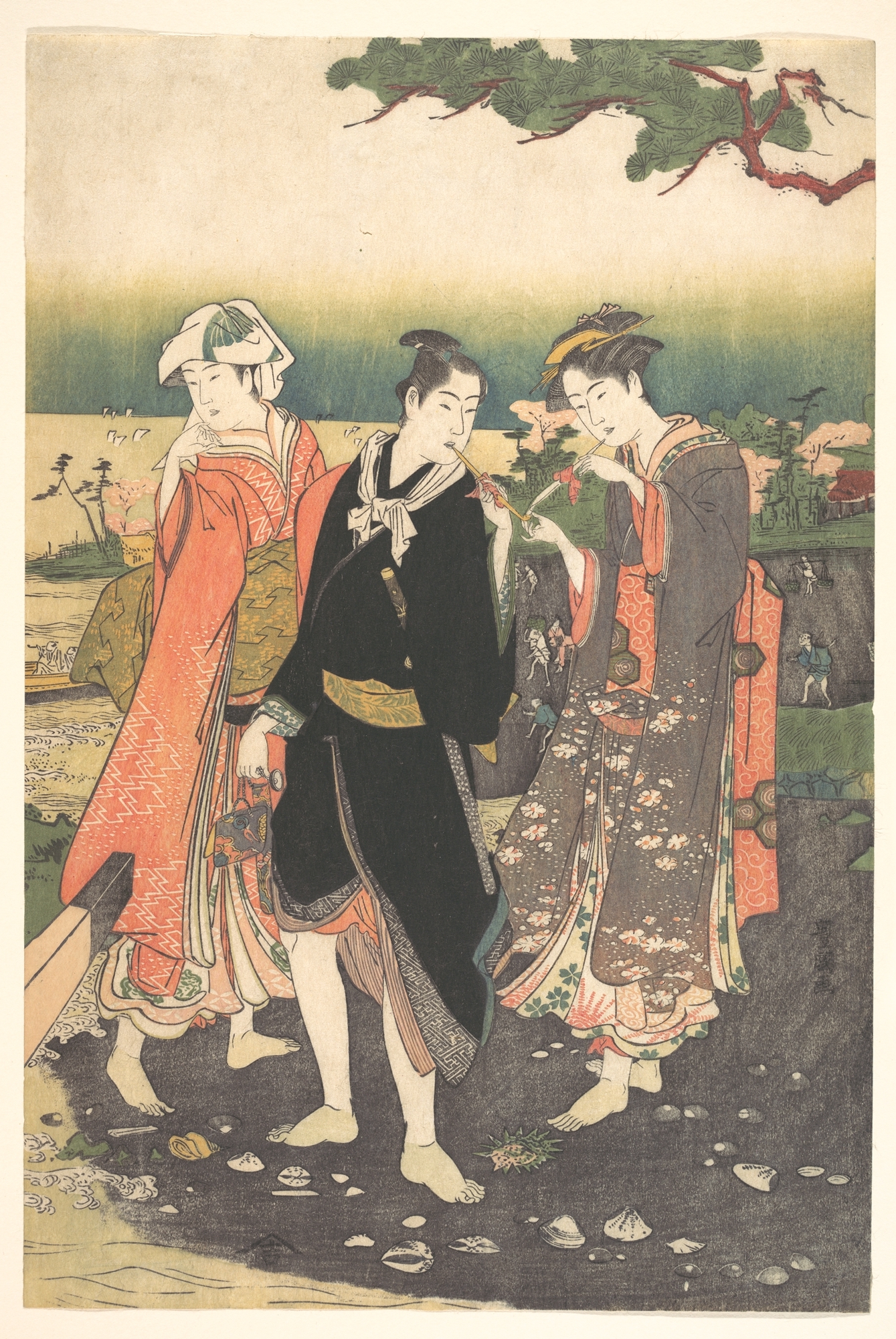
Parody of Liu Bei (J: Gentoku) Visiting Zhuge Liang (J: Komei) in Wind and Snow (Gentoku fusetsu ni Komei o tazureru)
- Date:
- c. 1844
- Medium:
- Color woodblock print; oban triptych
- Source:
- Art Institute of Chicago
This 1839 print by Utagawa Toyokuni in the Art Institute of Chicago belongs to the mitate-e (parody picture) tradition central to Edo ukiyo-e, transposing the famous Chinese story of Liu Bei (Gentoku) visiting Zhuge Liang (Komei) through wind and snow into an immediately recognizable nineteenth-century Japanese setting. The original episode, drawn from the "Romance of the Three Kingdoms," describes Liu Bei's three repeated visits to the secluded strategist Zhuge Liang, a sequence that became a touchstone for sincere persistence and respect for talent. The mitate format takes that famous narrative and overlays it onto contemporary figures, often kabuki actors or modish urbanites, generating a parodic but reverential image that allows the original story and the present moment to comment on each other. Toyokuni, as head of the Utagawa school, was well-versed in mitate-e and used it to extend the yakusha-e tradition outward into the wider classical canon. The compositional drama of wind and snow gives him scope for billowing textiles, hunched postures, and stark contrasts between figure and pictorial ground, all rendered in the disciplined Utagawa school linework characteristic of the late 1830s. The print exemplifies how Edo ukiyo-e thrived on intertextual play, allowing the Chinese classical tradition, the kabuki stage, and the commercial print marketplace to inform one another. For students of Utagawa Toyokuni and of the broader mitate-e tradition, the work is a particularly elegant late example.


early 1830s
Color woodblock print; shikishiban, surimono

1796
Woodblock print (nishiki-e), ink and color on paper
1769–1825
Woodblock print; ink and color on paper
Parody of Liu Bei (J: Gentoku) Visiting Zhuge Liang (J: Komei) in Wind and Snow (Gentoku fusetsu ni Komei o tazureru) was created by Utagawa Toyokuni I (歌川豊国) in c. 1844.
Parody of Liu Bei (J: Gentoku) Visiting Zhuge Liang (J: Komei) in Wind and Snow (Gentoku fusetsu ni Komei o tazureru) depicts winter.