
13
- Source:
- ukiyo-e.org
Description
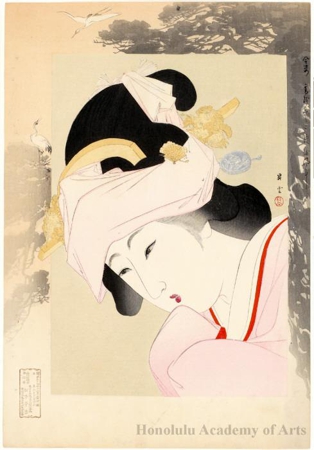
Plate 13 of Yamamoto Shoun's Women in Their Pursuits offers another deliberately quiet entry in the artist's serial portrait of late Meiji women. By the album's midpoint, Shoun's design language is well established: a solitary figure framed by generous unprinted ground, brushed outlines that taper like calligraphy, and a restricted palette designed to avoid the harshness of the aniline dyes that flooded the Meiji print market. Shoun, born in 1870 in Kochi prefecture and trained in both Kano and Maruyama-Shijo painting before turning to woodblock design in the early 1890s, brought a painter's economy of means to a genre that often risked over-decoration. Within the wider Meiji bijin-ga tradition, his choice of subject was unusually grounded; rather than reusing the courtesans, geisha, and stage beauties of Edo ukiyo-e, he documented the middle-class women of contemporary Tokyo at their daily activities. His companion album Ima Sugata (Modern Figures) shares the same impulse but focuses more on dress and bearing, while Women in Their Pursuits centers on vocation and pastime. The sheet is preserved in the Japanese Art Open Database indexed by ukiyo-e.org, which has assembled the entire album in proper order for serial study. Read against that broader sequence, plate 13 fulfills its role in the album's slow accumulation of detail, helping to build a composite portrait of a generation of Japanese women whose interior and outer lives had not been chronicled with comparable affection elsewhere in the Meiji print archive. It is a small image, but in the context of Shoun's career it is exemplary, demonstrating how a single restrained design could carry a great deal of cultural and historical weight.
More Prints by Yamamoto Shoun


Featured in Collections
Curated cross-cuts that include this print.
Frequently Asked Questions
13 was created by Yamamoto Shoun (山本昇雲).