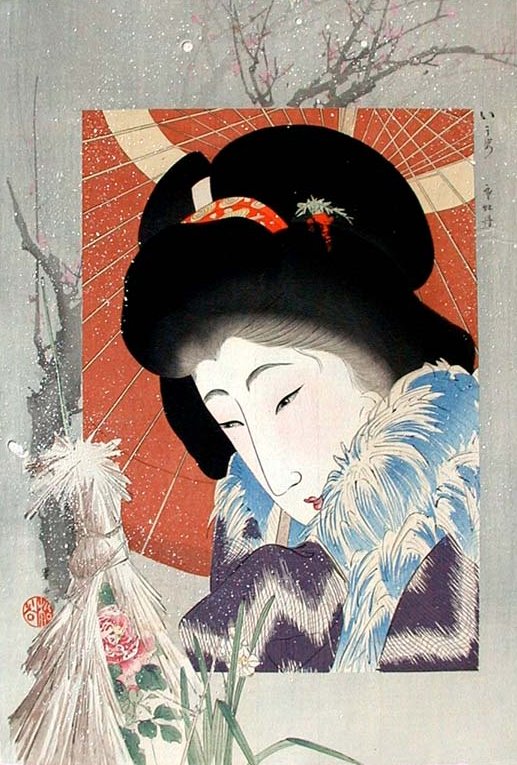
Biography
Yamamoto Shoun (山本昇雲, 1870–1965) lived into his mid-nineties and witnessed much of the arc of modern Japanese printmaking, from the twilight of Meiji-era ukiyo-e toward the emergence of shin-hanga. Born in the city of Kochi, in Kochi Prefecture on the island of Shikoku, on 30 December 1870, he trained as a painter before turning to woodblock print design. As a young man he studied Kano-school painting under Yanagimoto Doso and Kawada Shoryu, and after moving to Tokyo he studied Nanga (literati) painting with Taki Katei.
Shoun established himself in Tokyo around the 1890s and early 1900s as a designer of bijin-ga (pictures of beautiful women) and genre scenes of children at play. His early work appeared in the final flowering of traditional ukiyo-e publishing, with designs issued by established Meiji-era print houses. These prints depicted women in contemporary dress and hairstyles alongside scenes of daily life in Tokyo, rendered with the refined draftsmanship of a classically trained painter.
Among his best-known bodies of work is the series 'Children's Play' (Kodomo Asobi), published in 1906, which portrayed Japanese children engaged in seasonal games, festivals, and outdoor pastimes. These prints combined delicate figure drawing with bright, appealing colour harmonies, capturing lively, natural expressions that distinguished them from the more idealised conventions of earlier ukiyo-e depictions of children.
Shoun also worked as an illustrator and painter throughout his career: at about the age of twenty he was employed illustrating Fūzoku Gahō, a pictorial magazine devoted to the sights of Tokyo, and he produced images for books and magazines that reached audiences well beyond the print-collector community. His career carried across the Meiji, Taisho, and Showa periods, and he is often regarded as a bridge between late ukiyo-e and the shin-hanga sensibility that followed, owing to the gentle naturalism of his Meiji-period designs. He died in 1965 at the age of ninety-four. His children-at-play prints have become particularly collectible, valued both as art and as records of customs and seasonal traditions of early-twentieth-century Japanese childhood.
Key Facts
- Active Period
- 1870–1965
- Nationality
- 🇯🇵Japan
- Movement
- Shin-hanga
- Works Indexed
- 73
Frequently Asked Questions
Yamamoto Shoun (山本昇雲, 1870–1965) lived into his mid-nineties and witnessed much of the arc of modern Japanese printmaking, from the twilight of Meiji-era ukiyo-e toward the emergence of shin-hanga. Born in the city of Kochi, in Kochi Prefecture on the island of Shikoku, on 30 December 1870, he trained as a painter before turning to woodblock print design. As a young man he studied Kano-school painting under Yanagimoto Doso and Kawada Shoryu, and after moving to Tokyo he studied Nanga (literati) painting with Taki Katei.
Yamamoto Shoun was active from 1870 to 1965. They were associated with the Shin-hanga movement.
Yamamoto Shoun's work was shaped by the Shin-hanga tradition in Japanese woodblock printmaking. Shin-hanga: ## What is Shin-hanga? Shin-hanga (新版画), literally "new prints," is the early twentieth-century revival of the collaborative Japanese woodblock workshop, organized between roughly 1915 and 1960 by the Tokyo publisher Watanabe Shōzaburō (1885–1962) and a handful of competing houses.
Yamamoto Shoun's prints frequently feature birds & flowers, children, snow scenes, fish, spring, animals.
Original prints by Yamamoto Shoun can be found in collections including ukiyo-e.org.
External Resources
Woodblock Prints by Yamamoto Shoun (73)

Children and Carp Streamer
鯉のぼりと子供
c. 1906
Color woodblock print

Children Fishing
魚釣りをする子供
c. 1906
Color woodblock print
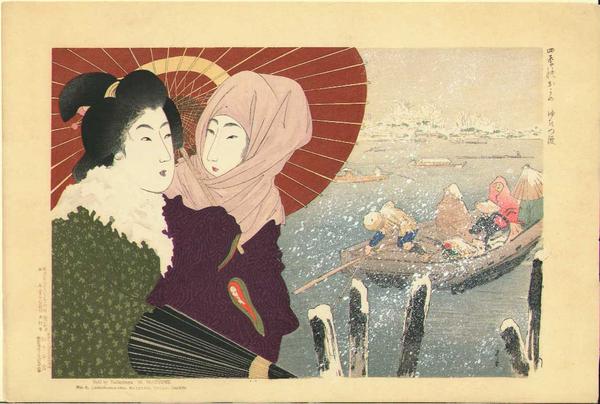
Snow Play
雪遊び
c. 1906
Color woodblock print

Children Playing in Summer
夏の子供遊び
c. 1906
Color woodblock print
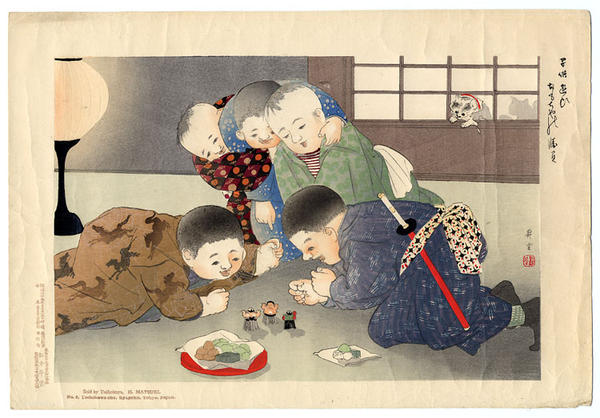
Children with Lanterns
提灯を持つ子供
c. 1906
Color woodblock print
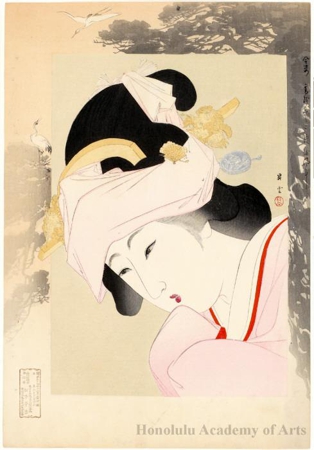
Beauty Under Umbrella
傘を差す美人
c. 1910
Color woodblock print
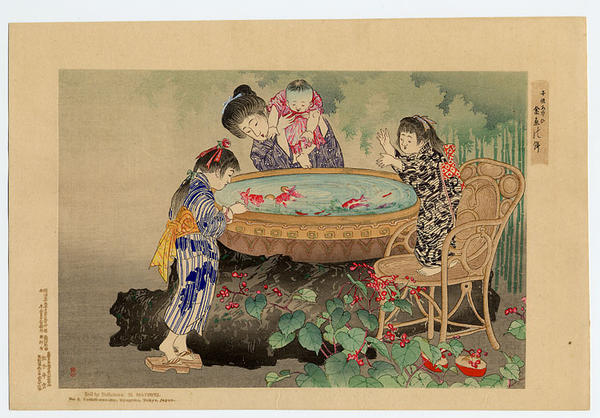
Goldfish Scooping
金魚すくい
c. 1910
Color woodblock print
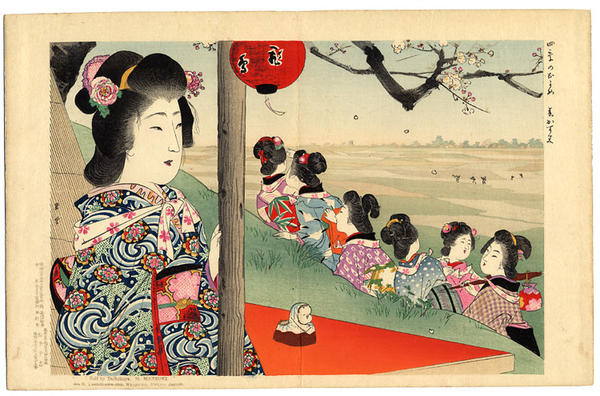
Spring Outing
春の遠足
c. 1910
Color woodblock print

21

God of Thunder
Mokuhanga (Japanese woodblock)

2

1

Winter Landscape
Mokuhanga (Japanese woodblock)

24

Baby and Mt Fuji

Dusk
Mokuhanga (Japanese woodblock)

Morning after snow
Mokuhanga (Japanese woodblock)

6

Fighting with Dolls, Children's Play

Waterfowl Standing on one leg
Mokuhanga (Japanese woodblock)

Two Girls
Mokuhanga (Japanese woodblock)

Swallows On wisteria
Mokuhanga (Japanese woodblock)

7

Rainy Shore
Mokuhanga (Japanese woodblock)