
14
- Source:
- ukiyo-e.org
Description
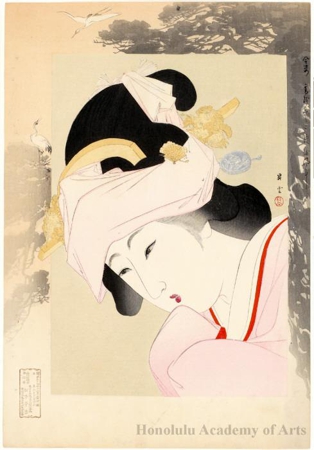
Plate 14 from Women in Their Pursuits is another in Yamamoto Shoun's careful sequence of Meiji-era women caught in the middle of an everyday activity. Shoun, born in 1870 in Kochi and educated in classical Kano and Maruyama-Shijo painting before turning to woodblock design in the 1890s, used the album to extend the Edo-era bijin-ga tradition into a more grounded, contemporary register. Where his predecessors had favored famous courtesans and stage beauties, he portrayed the wives, daughters, and workers of modernizing Tokyo, presenting them with the same compositional respect that earlier ukiyo-e masters had reserved for their celebrated subjects. The print is characteristic of his work in its restrained palette, brushed outlines, and generous use of unprinted paper, which together encourage the viewer to focus on posture and gesture rather than narrative drama. Shoun's parallel album Ima Sugata (Modern Figures) developed the same documentary impulse with a sharper focus on dress and external appearance, while Women in Their Pursuits centered on what the women in question were actually doing with their time, making it a particularly valuable record of late Meiji daily life. The print is preserved in the Japanese Art Open Database indexed by ukiyo-e.org, which catalogs the album as a complete sequence. Plate 14, like its siblings, gains depth from that serial context. On its own it reads as a quiet, lyrical observation, but as part of an extended cycle it contributes to a sustained meditation on the women whom Shoun saw as the often-overlooked protagonists of Japan's transition into modernity. It is the kind of Meiji bijin-ga that demonstrates how the genre could be both technically refined and warmly humane.
More Prints by Yamamoto Shoun


Featured in Collections
Curated cross-cuts that include this print.
Frequently Asked Questions
14 was created by Yamamoto Shoun (山本昇雲).