
16
- Source:
- ukiyo-e.org
Description
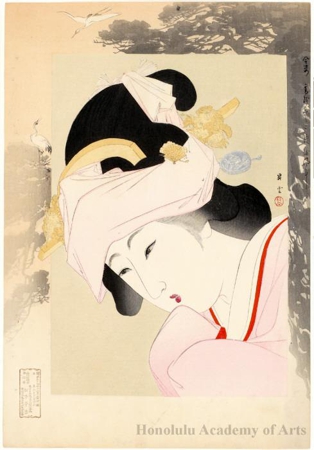
Plate 16 from Yamamoto Shoun's Women in Their Pursuits sits comfortably within the album's middle section, where Shoun has fully settled into the visual idiom that defines his contribution to Meiji bijin-ga. The image shows a single woman absorbed in an ordinary task, framed by generous white space and rendered with the brushed outlines and restrained palette that became his signature. Shoun, born in 1870 in Kochi prefecture, was trained first in Kano painting and then in Maruyama-Shijo before turning to woodblock design in the 1890s, and the combination of those classical schools shaped his graphic style. He carried over the calligraphic line, the willingness to leave the page largely empty, and the preference for soft modulated color rather than saturated commercial dyes. Within the larger Meiji bijin-ga tradition, his subject choice was quietly distinctive; rather than the famous courtesans and stage beauties of Edo ukiyo-e, he documented the everyday women of modernizing Tokyo. His parallel album Ima Sugata (Modern Figures) carried this impulse into a focus on outward appearance, while Women in Their Pursuits concentrated on the daily activities themselves. The print is preserved in the Japanese Art Open Database indexed by ukiyo-e.org, which has assembled the album as a digitized sequence for serial study. Plate 16 belongs to that sequence and contributes to its cumulative portrait of a generation of women. Read individually it offers a tender, low-key observation, and read alongside its siblings it confirms why Shoun is remembered as one of the most humane and consistent chroniclers of Meiji feminine life, building, sheet by sheet, an album that functions as both a work of art and a quiet sociological record.
More Prints by Yamamoto Shoun


Featured in Collections
Curated cross-cuts that include this print.
Frequently Asked Questions
16 was created by Yamamoto Shoun (山本昇雲).